Air Conditioning
F-gas regulation air conditioning 2027: R410A, R32, R290
Your R410A air conditioner is not banned in 2027. Regulation (EU) 2024/573 targets new equipment: heat pumps and monoblocs from 2027, air-to-air splits in 2029. What is still allowed, mandatory leak checks and how to choose in 2026.
· 11 min read · L'équipe technique VCN Energy
No, the EU F-gas Regulation does not ban your R410A air conditioner in 2027: you can keep using it, have it serviced and have it recharged. Regulation (EU) 2024/573 bans placing new equipment on the market: new R410A single splits have been off the market since 1 January 2025, and from 1 January 2027 the ban covers air-to-water heat pumps, monobloc and portable air conditioners up to 12 kW using a refrigerant with a GWP of 150 or more, which includes R32.
What does the F-gas Regulation (EU) 2024/573 say?
Regulation (EU) 2024/573 of 7 February 2024 entered into force on 11 March 2024, replacing the old Regulation 517/2014. It applies directly in Belgium without any national transposition. Its goal is to phase hydrofluorocarbons (HFCs) out of the EU market by 2050.
It combines shrinking HFC quotas, bans on new equipment, limits on the gases used for servicing, and inspection duties. In Belgium, the three Regions (Brussels, Wallonia and Flanders) handle technician approval and on-the-ground enforcement.
The key figure is the GWP (global warming potential): how much one kilo of a gas warms the climate compared with one kilo of CO2 over 100 years. For HFCs, the regulation uses the IPCC's Fourth Assessment Report values: 2,088 for R410A and 675 for R32. Propane (R290) is not an F-gas and has a GWP of about 3.
Watch the legal wording: "placing on the market" means the first time a unit is supplied on the EU market. A unit already placed on the market before a deadline can still be sold and installed; from one year after the ban, the distributor must be able to prove it was placed on the market lawfully, according to the European Commission.
What is banned, and from when?
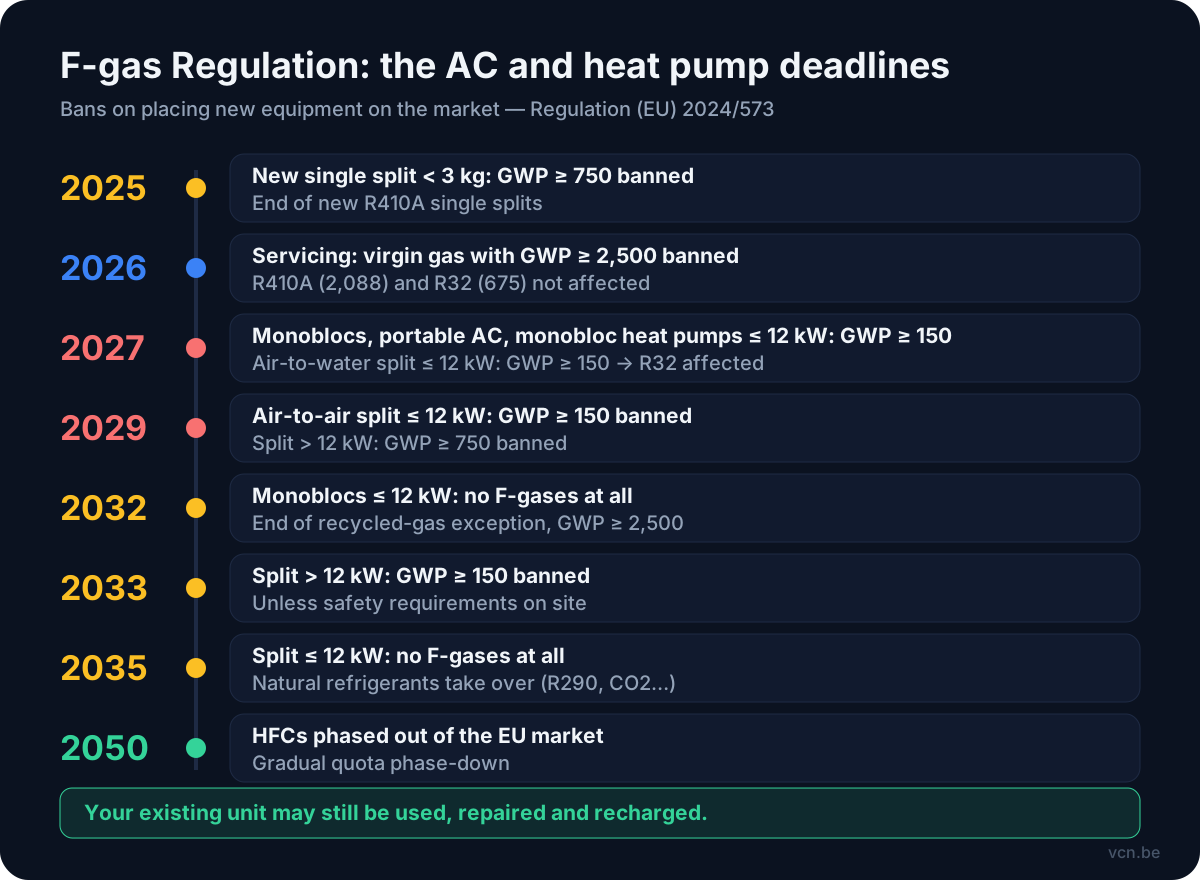
These are the deadlines that matter for homes, flats and small buildings. They all apply to new equipment.
| Type of equipment | Banned refrigerants | From |
|---|---|---|
| Single split holding less than 3 kg of gas | GWP ≥ 750 (incl. R410A) | 1 January 2025 |
| Portable AC, monobloc AC, monobloc heat pump ≤ 12 kW | GWP ≥ 150 (incl. R32) | 1 January 2027 |
| Monobloc from 12 to 50 kW | GWP ≥ 150 | 1 January 2027 |
| Air-to-water split heat pump ≤ 12 kW | GWP ≥ 150 | 1 January 2027 |
| Air-to-air split ≤ 12 kW (AC, reversible AC) | GWP ≥ 150 | 1 January 2029 |
| Split > 12 kW | GWP ≥ 750, then GWP ≥ 150 | 1 January 2029, then 2033 |
| Monobloc ≤ 12 kW | All F-gases | 1 January 2032 |
| Split ≤ 12 kW | All F-gases | 1 January 2035 |
Each ban carries an exception "if required to meet safety requirements" at the installation site. For monoblocs, the Commission explains that if safety rules out a gas below GWP 150, the limit becomes 750, so R32 remains possible in those specific cases.
Why do people talk about an "R410A ban in 2027"?
The phrase is misleading. New R410A single splits have been banned since 1 January 2025, and the 2027 deadline mainly targets heat pumps and monoblocs with a GWP of 150 or more, which also means R32.
R410A is getting scarcer mainly because of quotas: every year, fewer HFCs may be placed on the EU market. On top of that, importers and producers have paid EUR 3 per tonne of CO2 equivalent of quota since the 2026 allocation, according to the European Commission. Less gas means pricier recharges.
R410A, R32, R290: what is the difference?
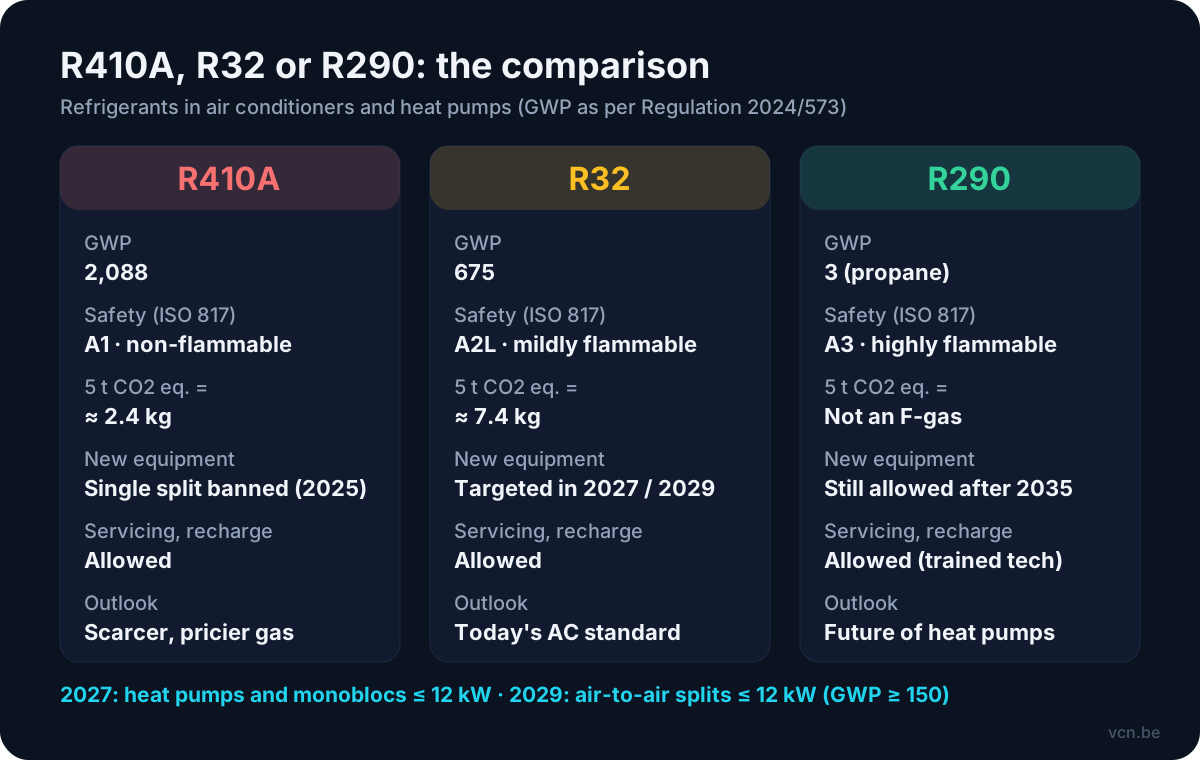
These three refrigerants differ in climate impact and in safety requirements. The ISO 817 safety class combines toxicity (A = low) and flammability (1 = none, 2L = mild, 3 = high).
| Refrigerant | GWP | Safety | 5 t CO2 eq. = | New equipment | Recharging |
|---|---|---|---|---|---|
| R410A | 2,088 | A1, non-flammable | ≈ 2.4 kg | Single split banned since 2025 | Allowed |
| R32 | 675 | A2L, mildly flammable | ≈ 7.4 kg | Targeted in 2027 (heat pumps, monoblocs) and 2029 (air-to-air splits) | Allowed |
| R290 (propane) | ≈ 3 | A3, highly flammable | Not applicable | Still allowed after 2035 | Allowed, by a trained technician |
R410A long equipped most air conditioners and heat pumps. It is non-flammable, but its high GWP makes it a dead end.
R32, today's standard in split air conditioners, has a GWP three times lower than R410A, but it is still above 150, like R454B (GWP 466).
R290 (propane) is a natural refrigerant outside the scope of the bans. Being highly flammable, it requires charge limits, safety distances (EN 378 standard, manufacturer's manual) and a technician trained in flammable refrigerants.
I already have AC or a heat pump: what is still allowed?
Almost everything. The regulation sets no end-of-use date for an R410A or R32 unit.
- Using the unit: allowed, with no end date.
- Servicing and repairing: allowed, by a certified refrigeration technician (called a frigoriste in French-speaking Belgium, koeltechnicus in Flanders).
- Recharging with R410A or R32: allowed. Since 1 January 2026, only virgin gases with a GWP of 2,500 or more are banned for servicing air conditioners and heat pumps (reclaimed or recycled gas is tolerated until 2032). R410A and R32 are below that threshold.
- Replacing parts: the regulation allows spare parts needed to repair existing equipment to be placed on the market.
- Keeping an R22 system: it may keep running, but R22 has been banned for servicing since 1 January 2015. At the first leak, replacement is the only option.
The real change is financial: R410A is becoming more expensive and less available as quotas fall. Spare-part availability for older models depends on each manufacturer. For any major repair, compare the cost with a replacement.
What should you actually do with an R410A unit?
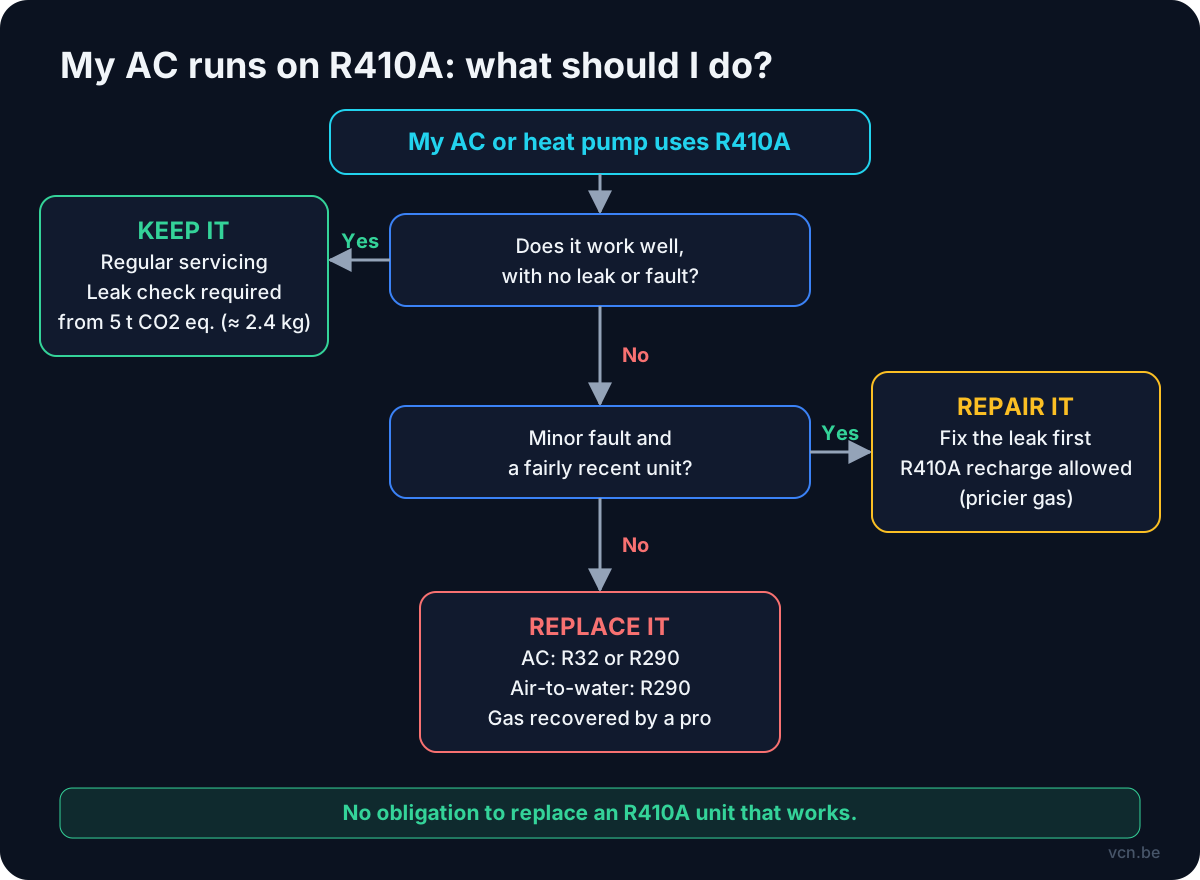
- Find the refrigerant and charge on the outdoor unit's rating plate: gas code (R410A, R32…), quantity in kg and, on recent units, in tonnes of CO2 equivalent.
- Work out the CO2 equivalent if it is missing: charge in kg × GWP ÷ 1,000. Example: 3.5 kg of R410A × 2,088 ÷ 1,000 = 7.3 t CO2 eq.
- Book regular servicing and, from 5 t CO2 eq., the periodic leak check.
- If there is a leak, repair before recharging. The regulation requires all technically and economically feasible measures to prevent emissions.
- Plan the replacement after a major failure (compressor, repeated leaks): that is the time to switch to R32 or R290.
Leak checks: when are they mandatory?
The threshold is not expressed in kilos but in tonnes of CO2 equivalent. Any unit holding at least 5 t CO2 eq. of HFCs must be checked by a certified person, at a frequency that depends on the charge.
| Charge in t CO2 eq. | Frequency | With leak detection system | R410A equivalent | R32 equivalent |
|---|---|---|---|---|
| 5 to under 50 | Every 12 months | Every 24 months | 2.4 to 24 kg | 7.4 to 74 kg |
| 50 to under 500 | Every 6 months | Every 12 months | 24 to 240 kg | 74 to 740 kg |
| 500 and over | Every 3 months | Every 6 months | Over 240 kg | Over 740 kg |
Hermetically sealed units labelled as such and holding less than 10 t CO2 eq. are exempt. A split system connected on site does not normally fall into that category.
In practice, a 1 kg R32 single split (0.7 t CO2 eq.) needs no legal leak check, while a 3.5 kg R410A multi-split does, every year. Propane is not an F-gas, so the EU leak-check rule does not apply, but in the Brussels-Capital Region, installations holding at least 3 kg of an alternative refrigerant must also be checked every year.
Who can work on it? Certification in Brussels, Wallonia and Flanders
Only a certified technician may work on the refrigerant circuit: installing, recharging, repairing, leak checking and recovering the gas. Regulation 2024/573 adds flammable refrigerants and energy efficiency to the training, with periodic refresher courses. Each Region runs its own approval scheme.
- Brussels: you need a qualified refrigeration technician working for a refrigeration company registered with Bruxelles Environnement (Leefmilieu Brussel), the regional environment agency. Installations with at least 5 t CO2 eq. of HFCs (or 10 to 100 kW of electrical power) fall under heading 132 of classified installations and require a logbook.
- Wallonia: the Walloon Air and Climate Agency (AwAC) approves refrigeration technicians, based on a certificate from a recognised exam centre, as well as refrigeration companies, and publishes lists of both.
- Flanders: the work must be done by an erkend koeltechnicus (a technician approved by the Departement Omgeving), who re-sits an update exam every five years and keeps the installation logbook.
Before signing a quote (devis / offerte), ask for the certificate or approval number of both the technician and the company. In Brussels, these numbers must also appear in the installation logbook.
Air-to-water heat pumps: why they come first
Most air-to-water heat pumps in Belgian homes are rated at 12 kW or less. From 1 January 2027, new monobloc and split models in that range can no longer be placed on the market with a refrigerant of GWP 150 or more, except under a safety exception. Widely used R32 is therefore targeted two years earlier than in air-to-air units.
Several major brands already offer propane (R290) monobloc heat pumps, which keep the whole refrigerant circuit inside the outdoor unit. That outdoor unit must respect the manufacturer's clearances from windows, basement openings and drains.
If you already own an R32 or R410A heat pump, nothing changes: you can use it, repair it and recharge it. Our air-to-water heat pump page explains how they work and how they are sized, and a heat pump service costs EUR 205 including VAT at VCN Energy (September 2026 rate).
Buying AC or a heat pump in 2026: how to choose a future-proof unit
- Avoid R410A: a "new" R410A unit comes from old stock, and its gas will keep getting more expensive.
- For air-to-air AC, R32 is still a sound choice in 2026: you can use and recharge it for its whole lifetime. R290 splits remain rare.
- For an air-to-water heat pump, favour R290: it is the technology manufacturers are developing for the post-2027 market.
- Check efficiency (SEER for cooling, SCOP for heating) and the outdoor unit's noise level.
- Use a certified installer who keeps the logbook and recovers the old gas.
- Plan servicing from day one: a well-maintained unit leaks less and lasts longer. Our VCN ONE heat pump plan starts at EUR 195 a year, annual service included.
To budget a new system, read our guide to air conditioning installation prices, or see our AC installation and reversible AC pages.
What should you do now?
If your R410A air conditioner works well, keep it and have it serviced: no rule forces you to replace it, in 2027 or later. If it leaks or breaks down, a diagnosis lets you compare repair and replacement honestly. If you are planning a purchase, choose a refrigerant that is ready for the 2027 and 2029 deadlines now.
VCN Energy, a heating engineer based in Grez-Doiceau, covers Walloon Brabant, Brussels and Wallonia for AC maintenance, AC repair and unit replacement. Book your visit online or call us on 010 80 20 92 (+32 10 80 20 92 from a non-Belgian phone).
Frequently asked questions
Is R410A banned from 2027?
No. Using R410A is not banned in 2027. Regulation (EU) 2024/573 has prohibited placing new R410A single splits (under 3 kg, GWP ≥ 750) on the market since 1 January 2025. From 1 January 2027, the ban targets new air-to-water heat pumps, monobloc and portable air conditioners up to 12 kW with a GWP of 150 or more. An R410A air conditioner already installed can keep running and be serviced.
Can I still recharge an R410A air conditioner?
Yes. Recharging an R410A air conditioner or heat pump remains legal in 2026 and beyond. Since 1 January 2026, the F-gas Regulation only bans virgin gases with a GWP of 2,500 or more for servicing, and R410A has a GWP of 2,088. The recharge must be done by a certified refrigeration technician after the leak has been repaired. The gas is, however, getting more expensive because of EU quotas.
Do I need to replace my air conditioner before 2027?
No, there is no such obligation. The F-gas Regulation bans apply to the sale of new equipment, not to the use of existing systems. An R410A or R32 air conditioner that works well can be kept and serviced. Replacement makes sense after a major breakdown, repeated leaks or on a very old unit, especially one still running on R22, which has been banned for servicing since 2015.
Will R32 be banned too?
R32 (GWP 675) is being phased out of new equipment, not existing systems. From 1 January 2027, it can no longer be used in new air-to-water heat pumps and monoblocs up to 12 kW, except under a safety exception. From 2029, the rule extends to air-to-air splits up to 12 kW, and from 2035 no F-gases at all are allowed in those splits. An R32 air conditioner bought in 2026 can still be recharged later.
Is a propane (R290) heat pump dangerous?
Propane (R290) is highly flammable (class A3), but heat pumps that use it are designed for it. Monobloc models keep all the gas in the outdoor unit, and installation must respect charge limits, the safety distances in the manual and the EN 378 standard. The technician must be trained in flammable refrigerants. Properly installed and maintained, an R290 heat pump is a safe and durable choice.
Does my air conditioner need a leak check?
Yes, if it holds at least 5 tonnes of CO2 equivalent of F-gas, roughly 2.4 kg of R410A or 7.4 kg of R32. The check is then mandatory every 12 months (every 24 months with a leak detection system) and must be carried out by a certified technician. Hermetically sealed units under 10 t CO2 eq. are exempt. In Brussels and Flanders, a logbook is also required.
Sources
- Regulation (EU) 2024/573 on fluorinated greenhouse gases — EUR-Lex
- Air conditioning: climate-friendly alternatives to F-gases — European Commission
- F-gases in equipment and products — European Commission
- F-gases in bulk (quotas) — European Commission
- Heat pumps, air-conditioning and refrigeration equipment — Bruxelles Environnement
- Refrigeration technician approval — Wallonia
- Refrigeration technicians: approvals and lists — AwAC
- Information for approved refrigeration technicians — Departement Omgeving (Flanders)
- The new F-gas Regulation: detailed guidelines — European Heat Pump Association
- F-Gas Guide 2024 — AREA
- Global Warming Potential — Fluorocarbons.org (EFCTC)