Plumbing
CertIBEau and rainwater: the little-known obligation in Brussels
In Brussels, a rainwater tank is mandatory for new builds and large extensions, with precise sizing. In Wallonia, CertIBEau governs network separation. What owners often don't know.
· 7 min read · L'équipe technique VCN Energy
Harvesting rainwater is not an optional eco-gesture everywhere in Belgium: in Brussels, a tank is mandatory for any new build, rebuild or extension over 20 m², with precise sizing based on roof area. In Wallonia, it is the CertIBEau certificate that governs any home with a private water source. Two different systems, one shared logic: strictly separating rainwater from the public network to avoid any risk of contamination.
Brussels: an obligation tied to the building permit, not a choice
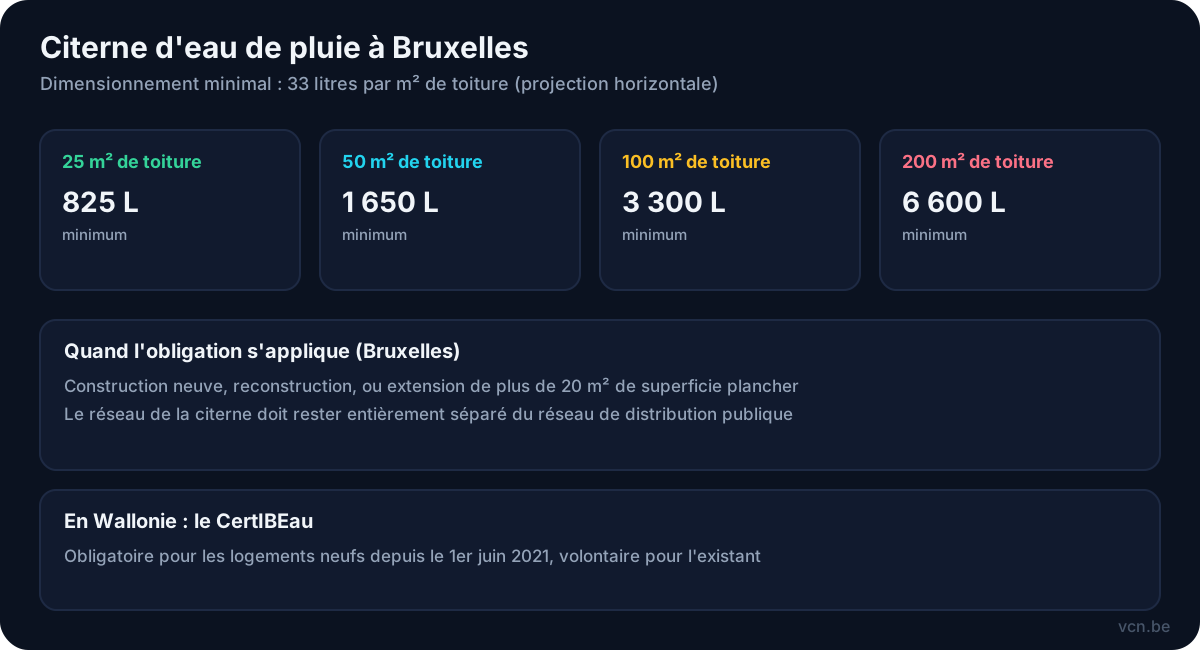
In Brussels, installing a rainwater harvesting tank is not left to the owner's discretion once a permit is involved: it is required for any new build, any rebuild, and any extension exceeding 20 m² of floor area. Minimum sizing is calculated from the roof area in horizontal projection, at 33 litres per m²: a 25 m² roof requires a tank of at least 825 litres, a 50 m² roof at least 1,650 litres, and so on up to 6,600 litres for a 200 m² roof.
The rule that matters most: keeping the networks separate
Beyond the volume, the central technical requirement concerns the installation itself: the distribution network fed by the rainwater tank must remain entirely separate from the public distribution network. In practice, no rainwater may flow back, even accidentally, into the pipes carrying drinking water from the public network. This is a health and safety rule, not an administrative formality: a poorly executed connection can contaminate the drinking water of an entire building, and potentially beyond it.
In Wallonia, CertIBEau plays that safeguard role
In the Walloon Region, CertIBEau, the Certificate for Real Estate Relating to Water, governs this separation. It has been mandatory for every new home since 1 June 2021, and remains voluntary for existing homes with a water source other than the public network (rainwater tank, well). The certificate confirms that the installation complies with network-separation rules and can be requested by the public network operator before any connection or during a sale.
Why this obligation remains little known among owners
Many owners discover these rules only at the time of a sale, a major renovation or an inspection, even though they are tied to the building permit from the outset. An undersized tank or a poorly separated network can lead to a non-compliance finding discovered late, with corrective works costing more than if they had been planned from the design stage. For a bathroom or kitchen renovation that touches the existing plumbing, this is the right moment to check whether the water installation complies with these separation rules.
What VCN Energy checks on your water network
VCN Energy works on plumbing in Brussels and Walloon Brabant, handling leak detection, plumbing repairs and the installation of sanitary water equipment, including checking existing connections. If your harvested rainwater also feeds a water softener or a sanitary circuit, water softener servicing costs €130 excl. VAT at VCN Energy (price listed in October 2026) and lets us check the general condition of your water network at the same time.
Book a visit online, ask for a free plumbing quote, or call 010 80 20 92 to have an existing installation checked before a sale or renovation, including through our plumber in Brussels team.
Frequently asked questions
Do I need to install a rainwater tank if I renovate my home in Brussels?
The obligation targets new builds, rebuilds and extensions over 20 m² of floor area. A renovation that does not fall into these categories is not automatically covered, but it is worth checking the exact permit with your municipality.
What tank size do I need for my roof?
In Brussels, the rule is a minimum of 33 litres per m² of roof in horizontal projection: for example 825 litres for 25 m², 1,650 litres for 50 m², 3,300 litres for 100 m² and 6,600 litres for 200 m².
What is CertIBEau and where does it apply?
CertIBEau is a Walloon certificate confirming that a water installation with a private source (tank, well) complies with the rules. It has been mandatory for every new home since 1 June 2021 and voluntary for existing homes.
Why is keeping the networks separate so important?
Because a poorly executed connection can let non-potable rainwater flow back into the drinking water network, creating a real health risk for the building and potentially beyond it.
What happens if my installation is not compliant?
Non-compliance found during a sale or inspection can require corrective works, often more costly than an installation properly designed from the start. A preventive check remains the cheapest option.
Sources
- Citerne d'eau de pluie en Belgique en 2026 — Housing Service
- Fiche info citerne d'eau de pluie — Commune of Uccle
- CertIBEau explicatif — City of Limbourg
- Quelle citerne installer pour la récupération d'eau de pluie ? — Test-Achats
- Assainissement, eau et toitures : réglementation pour l'évacuation — Buildwise