Plumbing
Water hardness in Brussels and Walloon Brabant: 2026 map
Water hardness by municipality in Brussels and Walloon Brabant (September 2026), °f, °dH and mmol/l explained, what limescale does to boilers, water heaters and heat pumps, and which solutions are proven.
· 12 min read · L'équipe technique VCN Energy
Tap water in Brussels and Walloon Brabant is hard to very hard almost everywhere. In Brussels, the water company VIVAQUA supplies two very different waters: about 37 to 38 °f (French degrees, roughly 21 °dH) in the east and centre, and about 19 °f in the west and most of Uccle. In Walloon Brabant, the in BW and SWDE lookup tools showed 30 to 45 °f for roughly three out of four addresses we checked in September 2026, including Wavre, Grez-Doiceau, Rixensart, La Hulpe, Nivelles and Jodoigne.
What is the water hardness in each Walloon Brabant municipality?
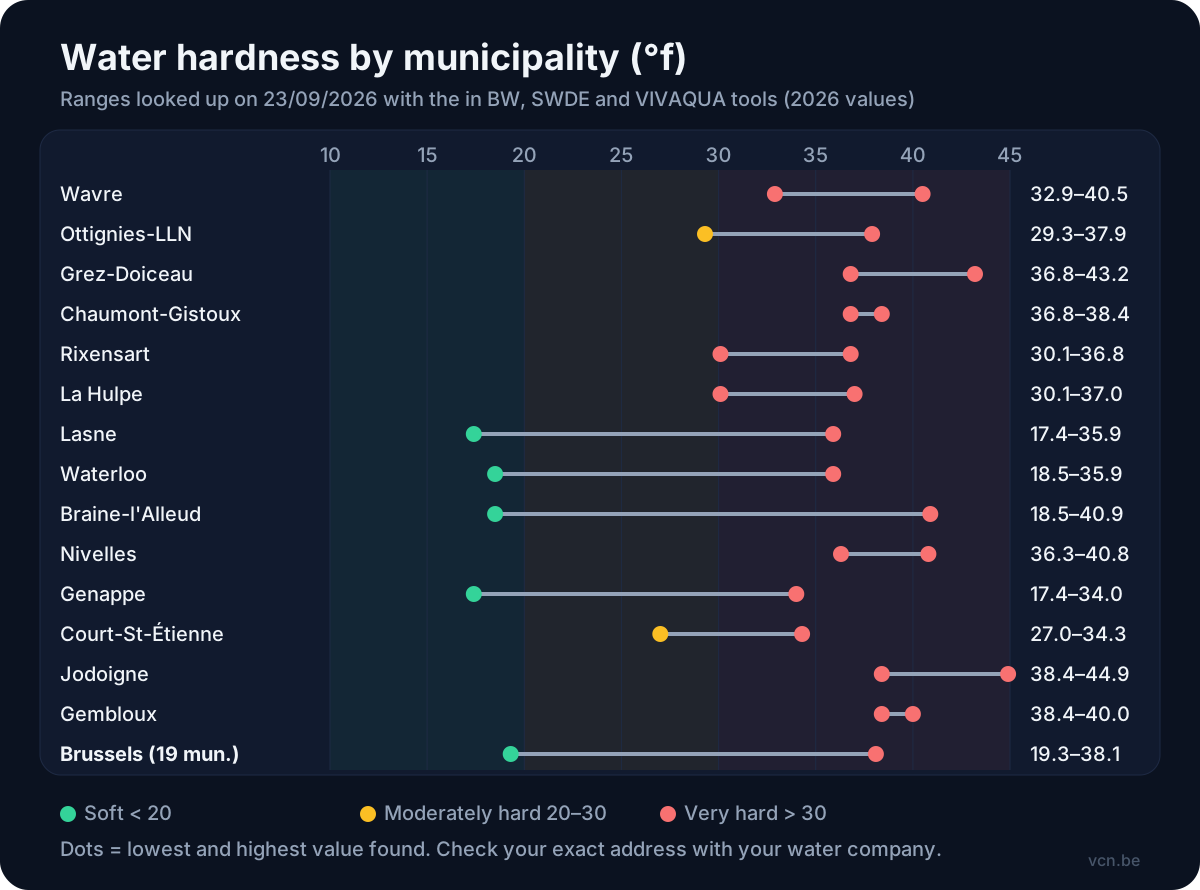
On 23 September 2026 we queried, address by address, the official tools of the three water companies: in BW ("Connaître la qualité de l'eau à mon robinet"), SWDE ("Qualité d'eau") and VIVAQUA ("La qualité de l'eau dans votre rue"). A municipality (commune) can be supplied by several networks, so we give a range and the detail by district.
| Municipality | Water company | Hardness (°f) | Equivalent (°dH) | Detail |
|---|---|---|---|---|
| Wavre | in BW | 32.9 – 40.5 | 18.4 – 22.7 | Centre 32.9 to 39.6; Bierges mostly 32.9; Limal mostly 40.5 |
| Ottignies-Louvain-la-Neuve | in BW | 29.3 – 37.9 | 16.4 – 21.2 | Louvain-la-Neuve and Ottignies mostly 29.3; Limelette and Céroux-Mousty 34.0 to 34.3 |
| Grez-Doiceau | SWDE | 36.8 – 43.2 | 20.6 – 24.2 | Three zones: 36.8 (water bought from De Watergroep), 41.5 (Pécrot), 43.2 (Nodebais); no data for 7 of 12 addresses |
| Chaumont-Gistoux | SWDE | 36.8 – 38.4 | 20.6 – 21.5 | 36.8 (De Watergroep water) or 38.4 (VIVAQUA water) |
| Rixensart | in BW + SWDE | 30.1 – 36.8 | 16.9 – 20.6 | Genval 30.1 (in BW); Rixensart and Rosières 35.6 to 36.8 (SWDE) |
| La Hulpe | in BW | 30.1 – 37.0 | 16.9 – 20.7 | Mostly 37.0 |
| Lasne | in BW | 17.4 – 35.9 | 9.7 – 20.1 | Ohain 35.9; Lasne, Couture and Maransart 34.0; Plancenoit mostly 17.4 |
| Waterloo | in BW | 18.5 – 35.9 | 10.4 – 20.1 | 38 of 44 addresses at 18.5; a few streets at 29.3 or 35.9 |
| Braine-l'Alleud | in BW + SWDE | 18.5 – 40.9 | 10.4 – 22.9 | Centre 18.5 or 40.9 depending on the area; Lillois and Ophain 22.6 (SWDE) |
| Nivelles | SWDE | 36.3 – 40.8 | 20.3 – 22.8 | Nivelles 36.3; Baulers 40.8 |
| Jodoigne | SWDE | 38.4 – 44.9 | 21.5 – 25.1 | Centre 38.4 or 42.6; Saint-Jean-Geest 44.9; no data for 8 of 13 addresses |
| Genappe | in BW | 17.4 – 34.0 | 9.7 – 19.0 | Genappe, Glabais and Ways 34.0; Baisy-Thy and Houtain-le-Val 30.2; Vieux-Genappe 21.8 to 34.0 |
| Court-Saint-Étienne | in BW | 27.0 – 34.3 | 15.1 – 19.2 | Two main values: 27.0 and 34.0 |
| Gembloux (Namur province) | SWDE | 38.4 – 40.0 | 21.5 – 22.4 | Spy zone 40.0; VIVAQUA water 38.4; many addresses without data |
How to read these values
in BW gives one value per sector ("sample taken in 2026"). SWDE shows the average of its supply zone; in Jodoigne the report covers 1 January 2025 to 31 March 2026. VIVAQUA publishes a monthly average: we used July 2026, the latest month available.
We tested a sample of streets (10 to 44 addresses per village), not every house. SWDE's tool also answers "paramètres non disponibles" (data not available) for part of the addresses in Grez-Doiceau, Chaumont-Gistoux, Jodoigne and Gembloux: for those streets, ask SWDE directly.
What is the water hardness in Brussels?
All 19 Brussels municipalities get their water from VIVAQUA, which produces about 70% groundwater and 30% surface water (from the Meuse at Tailfer), according to Brussels Environment. Our sample of 8 streets per postcode, using the July 2026 averages, shows two clear groups depending on which reservoir feeds your street.
| VIVAQUA reservoir | Hardness (July 2026) | Mainly in |
|---|---|---|
| Rhode | 37.1 °f – 20.8 °dH – 3.7 mmol/l | Etterbeek, Ixelles, Auderghem, Watermael-Boitsfort, Woluwe-Saint-Pierre, Woluwe-Saint-Lambert, Evere, Neder-over-Heembeek, Haren, part of Schaerbeek |
| Ixelles | 38.1 °f – 21.3 °dH – 3.8 mmol/l | Much of Brussels 1000, part of Saint-Gilles |
| Boitsfort | 36.9 °f – 20.7 °dH – 3.7 mmol/l | Saint-Josse, Molenbeek, part of Schaerbeek, Saint-Gilles, Laeken, Koekelberg and Anderlecht |
| Callois | 19.3 °f – 10.8 °dH – 1.9 mmol/l | Berchem-Sainte-Agathe, Ganshoren, Jette, Forest, most of Uccle and Anderlecht |
| Uccle / Daussoulx-Boitsfort feeder | 25.2 to 29.2 °f | A few streets in Uccle |
Hardness also shifts month by month. At one address supplied by Callois, VIVAQUA shows 14.6 to 23.1 °f between April 2025 and July 2026; at an Ixelles address supplied by Rhode, 35.2 to 40.2 °f. Set your appliances to the top of your range.
°f, °dH, mmol/l: which unit and which classes?
Hardness measures dissolved calcium and magnesium. Belgian water companies use French degrees (°f or °fH), dishwashers and German manuals use German degrees (°dH), and labs use mmol/l. Conversion: 1 °f = 0.56 °dH = 0.1 mmol/l; according to in BW and SWDE, 1 °f equals 4 mg of calcium per litre. If you come from the UK, note that 1 °f equals 10 ppm (mg/l) of calcium carbonate.
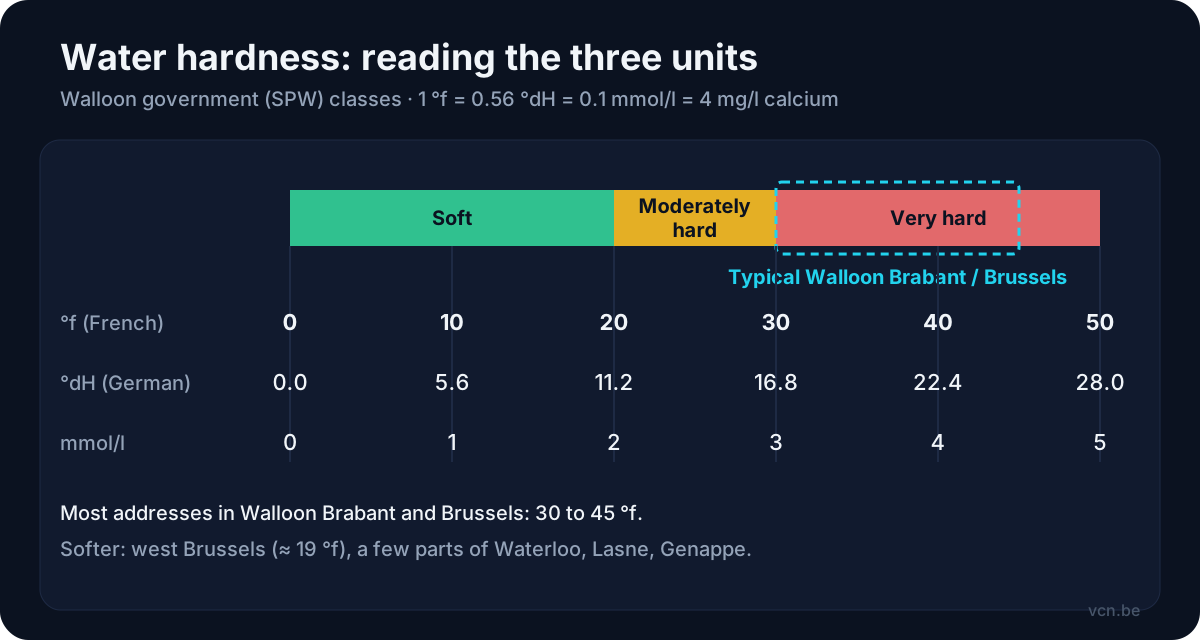
Classes differ by source. The SPW uses three: soft below 20 °f, moderately hard from 20 to 30 °f, very hard above. The in BW and SWDE tools use a finer scale (very soft up to 7 °f, soft up to 15 °f, moderately hard up to 25 °f, then hard and very hard), and VIVAQUA calls 25 to 40 °f "hard". Water at 37 °f is therefore "very hard" for the SPW and "hard" for VIVAQUA.
How do you find the exact hardness at your address?
- Find your water company on your water bill (in BW, SWDE, VIVAQUA, or De Watergroep or Farys in the Flemish suburbs).
- Enter your address in its online tool (links in the sources below); results are mostly shown in French or Dutch.
- Note the value in °f and download the report if there is one: it also shows sodium and the period covered.
- No result? Contact the water company or use a drop test kit, which is more accurate than test strips.
- Convert to °dH for your dishwasher and keep the value to set up a softener.
What does limescale do to your boiler, hot-water tank and heat pump?
A word on Belgian vocabulary first: locals often call the hot-water storage tank the "boiler", while the central-heating appliance is the "chaudière" (French) or "ketel" (Dutch). Limescale forms mainly when water is heated, De Watergroep explains: harder water does not automatically mean more scale, it is the temperature that makes the calcium precipitate. The parts that heat tap water are the most exposed.
Gas or oil boiler: mostly the hot-water circuit
The heating circuit (radiators, underfloor heating) is closed: it only scales once, from the fill water. The German guideline VDI 2035, which many manufacturers follow, allows up to 16.8 °dH (30 °f) in the fill water of systems under 50 kW, under conditions. With 35 to 40 °f water, a first fill or a large top-up deserves treatment; check your boiler manual.
The real weak spot is the plate heat exchanger of a combi boiler, which heats tap water every time you open a hot tap. With very hard water it scales up, the hot-water flow drops and the temperature fluctuates: something to check during gas boiler maintenance. In the UK, the 2013 official compliance guide requires scale treatment of the water feeding water heaters and the hot-water circuit of combi boilers whenever hardness exceeds 200 ppm, i.e. 20 °f.
Electric water heater, gas water heater and tankless heater
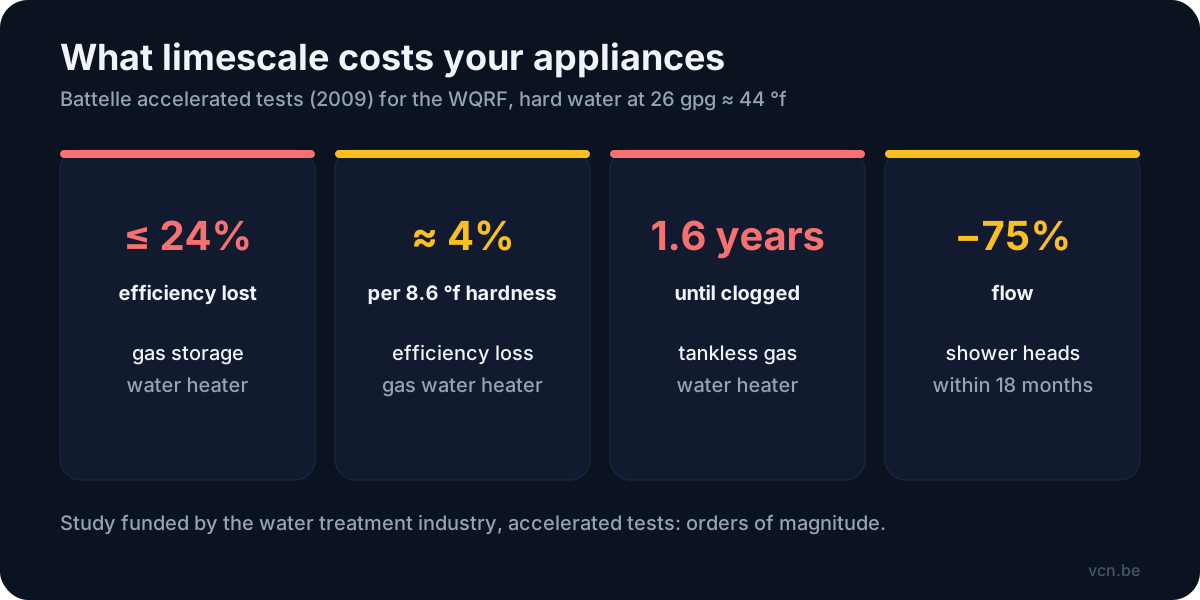
The most quoted study was carried out in 2009 by the Battelle institute for the Water Quality Research Foundation, with hard water at 26 grains per gallon (about 44 °f) and accelerated tests. Results: up to 24% efficiency lost on a gas storage water heater, about 4% loss per 5 gpg (8.6 °f) of hardness, and a tankless gas heater completely clogged after the equivalent of 1.6 years. For the electric water heater, efficiency stayed stable, but 907 g of scale built up per year versus 14 g with softened water: the heating element takes the hit, hence the value of regular electric water heater maintenance.
Heat pump and heat-pump water heater
A heat pump's heating circuit is closed too. The risk is on the tap-water side: the tank's heat exchanger, the electric backup element and the anti-legionella cycle, which heats water to a high temperature, all encourage deposits. A scaled tank transfers heat less well and can make the backup element work harder. Have the anode and tank checked during heat pump maintenance.
As for taps and appliances: in the same study, shower heads in hard water lost 75% of their flow in under 18 months, and dishwashers and washing machines were scaled after 30 test days.
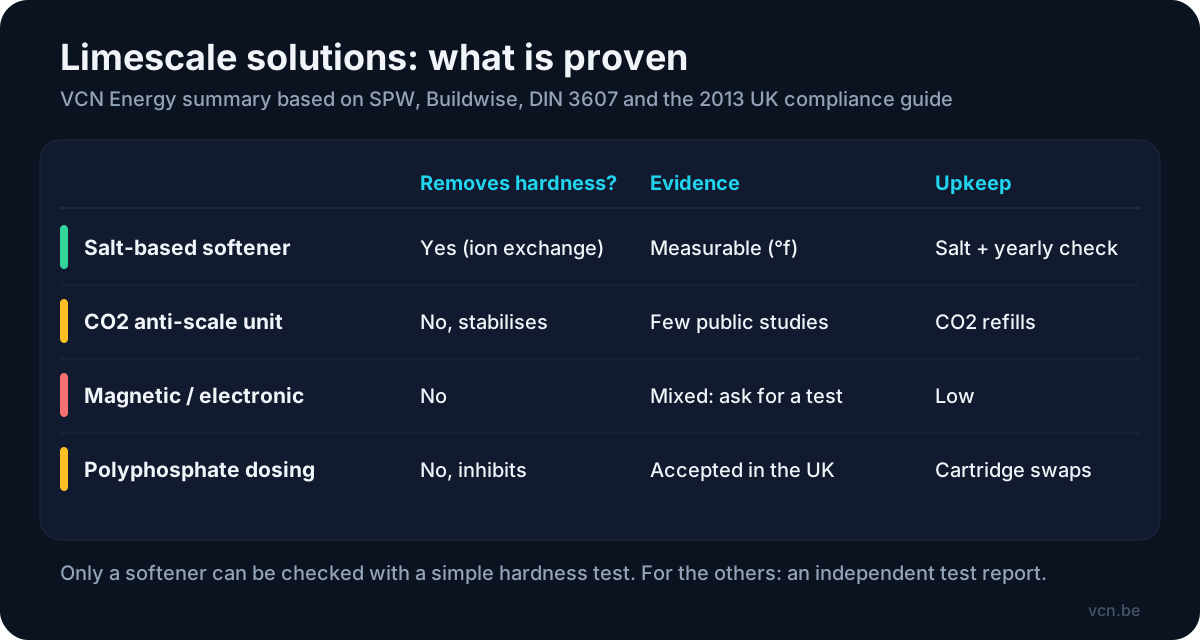
Softener, CO2, magnetic: what actually works?
| Solution | How it works | What is proven | Best for |
|---|---|---|---|
| Salt-based water softener | Ion-exchange resin swaps calcium and magnesium for sodium | Effect measurable in °f at the outlet | Whole house with very hard water (above 30 °f) |
| CO2 anti-scale unit | Carbon dioxide keeps limescale in solution | Does not lower hardness; few independent evaluations published | People who refuse salt, after asking for proof |
| Magnetic, electronic, electrolytic | A field or current is meant to change crystal formation | Mixed results; in Germany, standard DIN 3607 (2023) sets an efficacy test | Only with an independent test certificate |
| Polyphosphate dosing | Inhibits scale formation | Accepted by the 2013 UK guide for combi boilers | Targeted protection of a boiler or water heater |
Why so cautious? You cannot check a "physical" device by measuring hardness, which stays the same. That is why Buildwise, the Belgian construction research centre, ran the EVACODE project (2019-2021, with the Federal Economy Service and the Belgian standards body NBN): to develop an objective test method, with a European standard in view. Without an independent test report, a device has proven nothing.
What residual hardness should you set on a softener?
A well-adjusted softener does not go down to 0 °f: a mixing valve lets some hard water through. Rules differ by region, hence our cautious advice: about 15 °f.
- Brussels: the Brussels Environment report on water quality 2017-2019 states that water is no longer drinkable if it is softened below 15 °f.
- Wallonia: the SPW now states that softened water must stay above 10 °f; a January 2021 parliamentary answer quoted Annex XXXI of the Walloon Water Code, which set 15 °f.
- Flanders: De Watergroep advises keeping "a little calcium" in your tap water, good for your health and your pipes.
To set up your unit:
- Enter the incoming hardness in the softener (top of your range).
- Run a cold tap downstream of the softener and measure with a drop test.
- Adjust the mixing valve to 12 to 15 °f, then check again after a regeneration: this is part of any proper water softener installation.
- Set your dishwasher to the residual hardness (15 °f = 8.4 °dH), not to the mains value.
Over-softened water becomes aggressive to pipes, warn the SPW and SWDE.
Is hard water bad for your health?
No. The World Health Organization (2011 background document) proposes no guideline value for hardness, for lack of sufficient data, and SWDE states that very hard water "presents no health risk".
The point to watch is the sodium added by a softener. The EU Drinking Water Directive 2020/2184 sets an indicator value of 200 mg/l. By calculation, each French degree removed adds about 4.6 mg/l of sodium. Softening from 38 to 15 °f therefore adds around 105 mg/l, on top of the sodium already present (15 mg/l in SWDE's Jodoigne zone, for example). On a low-salt diet, keep one unsoftened tap in the kitchen.
Maintenance: what and when?
- Gas or oil boiler: yearly service including the hot-water heat exchanger; descale if hot-water flow or temperature drops.
- Electric water heater: check the anode and drain sediment, more often with very hard water.
- Heat pump: have the tank, anode and backup element checked during the service.
- Water softener: check the salt monthly and book a yearly softener service including a residual hardness check.
At VCN Energy, servicing a gas boiler costs €159 incl. VAT, an oil boiler €209, a heat pump €205 and a water softener €130 (September 2026 prices). The VCN ONE plan includes the yearly service, from €149 a year for gas.
Protect your appliances from limescale
Hard water in Brussels and Walloon Brabant is not a health risk, but doing nothing costs money: a scaled heat exchanger, a worn-out water heater, tired appliances. First check the value for your street, then choose a solution with proven effect. Our technicians work from Grez-Doiceau across Walloon Brabant and Brussels: book a service or visit online, call 010 80 20 92 or email [email protected].
Frequently asked questions
What is the water hardness in Brussels?
It depends on the reservoir feeding your street. In July 2026 VIVAQUA reported 36.9 to 38.1 °f (about 21 °dH, 3.7 to 3.8 mmol/l) for areas supplied by the Rhode, Ixelles and Boitsfort reservoirs, which covers most municipalities, and 19.3 °f for the Callois area (Berchem-Sainte-Agathe, Ganshoren, Jette, Forest, most of Uccle and Anderlecht). Values also move by a few degrees from month to month.
Is Brussels tap water hard or soft?
In most of Brussels it is hard: about 37 to 38 °f, which the Walloon government scale would call very hard and VIVAQUA calls hard. The west of the city and much of Uccle receive softer water, around 19 °f in July 2026. It is safe to drink either way. Check your exact street on VIVAQUA's "La qualité de l'eau dans votre rue" tool.
How hard is the water in Walloon Brabant?
Very hard in most municipalities. Out of nearly 1,000 results we pulled from the in BW and SWDE tools in September 2026, about three in four were above 30 °f, and some zones reach 43 to 45 °f (Grez-Doiceau, Jodoigne). Exceptions are a few areas of Waterloo, Lasne, Genappe and Braine-l'Alleud, between 17 and 23 °f. Always check your exact address.
Do I need a water softener in Brussels?
No rule requires one. The 2013 UK official guide offers a useful threshold: scale treatment is required for water heaters and combi boilers above 200 ppm, i.e. 20 °f. Where Brussels water is 37 to 38 °f, a softener effectively protects the hot-water heat exchanger, the water heater and appliances. If you install one, set it to keep about 15 °f, the threshold cited by Brussels Environment for softened drinking water.
Do magnetic water softeners work?
Results are mixed and hard to verify, because these devices do not change measured hardness. Buildwise ran the EVACODE project (2019-2021) to design an objective test method, and Germany has had standard DIN 3607 since 2023 to test anti-scale devices. Before buying, ask for an independent test report; without it, there is no guarantee of any effect.
Can you drink softened water?
Yes, if the softener is set correctly, with a residual hardness of about 15 °f. A softener replaces calcium with sodium: about 4.6 mg/l of sodium per French degree removed. With correct settings you stay below the EU indicator value of 200 mg/l. If you follow a low-salt diet, keep an unsoftened tap for drinking and cooking.
Sources
- Connaître la qualité de l'eau à mon robinet (outil par adresse) — in BW
- Qu'est-ce que la dureté de l'eau ? — in BW
- Qualité d'eau (outil par adresse) — SWDE
- Rapport d'analyse, zone de distribution 1326 (période 01/2025-03/2026) — SWDE
- Comment lire le rapport sur la qualité de l'eau ? — SWDE
- Dureté de l'eau – La qualité de l'eau dans votre rue — VIVAQUA
- Water quality on your street — VIVAQUA
- Dureté (qualité de l'eau de distribution) — SPW Environnement
- Un nouvel outil cartographique pour consulter la qualité de l'eau potable en Wallonie (26/03/2026) — SPW Environnement
- Qualité de l'eau distribuée par réseau 2017-2019 — Bruxelles Environnement
- Eau de distribution : approvisionnement et consommation — Bruxelles Environnement
- Les obligations en matière de dureté de l'eau (question du 05/01/2021) — Parlement de Wallonie
- Waterhardheid — De Watergroep
- Jouw drinkwater (tool per adres) — De Watergroep
- Veelgestelde vragen: waterhardheid en ontharding — De Watergroep
- Watersamenstelling en hardheid in jouw gemeente — Farys
- Hardness in drinking-water, background document (WHO/HSE/WSH/10.01/10/Rev/1, 2011) — Organisation mondiale de la santé
- Directive (UE) 2020/2184 relative à la qualité des eaux destinées à la consommation humaine — EUR-Lex
- Efficacité des appareils antitartres – EVACODE — Buildwise
- Kalkschutzgeräte zum Einsatz in Trinkwasser-Installationen (DIN 3607-1/-2:2023-05) — DVGW CERT
- Domestic Building Services Compliance Guide, 2013 edition — UK Department for Communities and Local Government
- Softened Water Benefits Study – executive summaries (Battelle, 2009-2010) — Water Quality Research Foundation
- Softened Water Benefits Study – Energy Savings — Water Quality Association
- VDI 2035: Grenzwerte für Leitwert, Härte & pH — Orben Wasseraufbereitung