Heating
Boiler service certificate Belgium: 2026 rules by region
Heating oil every year, gas every 2 or 3 years depending on the region: what Belgian law says in 2026, what the certificate shows, who pays in a rental and why your insurer wants to see it.
· 11 min read · L'équipe technique VCN Energy
Yes: in Belgium, regular servicing and inspection of a central heating boiler is a legal requirement in all three regions, and every visit must end with a certificate signed by an approved technician. As of September 2026, heating oil and wood boilers must be inspected every year everywhere; gas boilers every 2 years in Brussels and Flanders, and every 3 years in Wallonia (every 2 years above 100 kW). That certificate is what your insurer, your landlord or a regional inspector will ask to see.
What are the boiler servicing rules in each Belgian region?
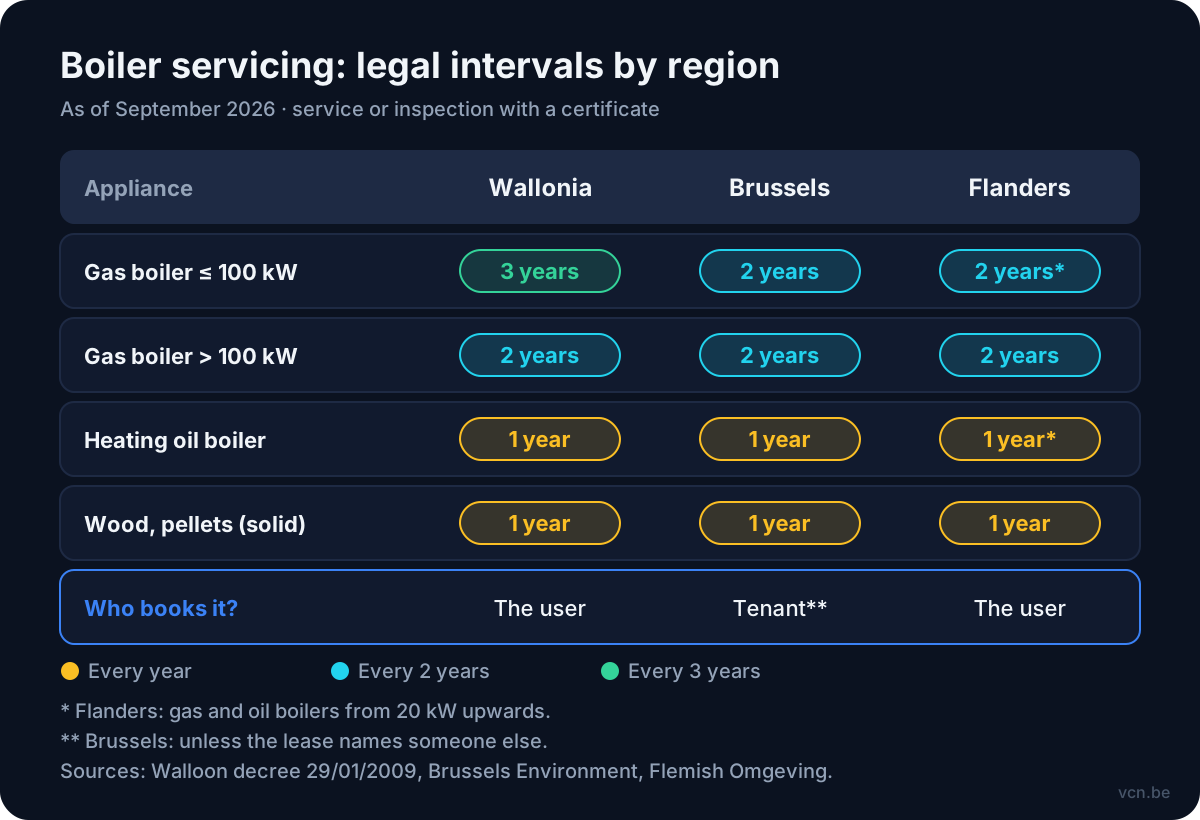
Boiler servicing is a regional matter, so Belgium has three sets of rules. The table sums up the intervals in force in September 2026, checked against the regional authorities. In Brussels you will see the acronym PEB (EPB in Dutch): it stands for the energy performance of buildings.
| Appliance | Brussels | Wallonia | Flanders |
|---|---|---|---|
| Gas boiler ≤ 100 kW | every 2 years | every 3 years | every 2 years (from 20 kW) |
| Gas boiler > 100 kW | every 2 years | every 2 years | every 2 years |
| Heating oil boiler | every year | every year | every year (from 20 kW) |
| Wood, pellets, coal | every year | every year | every year (any output) |
| Who books it? | the tenant, unless the lease says otherwise | the user (occupant) | the user (tenant) |
| Document issued | PEB periodic inspection certificate | "attestation de contrôle périodique" | "reinigings- en verbrandingsattest" |
| Deadline if non-compliant | 5 months | 5 months | 3 months |
Brussels: the PEB periodic inspection
Since 1 January 2019, Brussels requires gas boilers and gas water heaters to be inspected every 2 years (previously every 3), and heating oil and solid-fuel boilers every year.
According to Brussels Environment (Bruxelles Environnement / Leefmilieu Brussel), the tenant must arrange the inspection unless the lease assigns it to someone else, such as the landlord or the "syndic" (the managing agent of a co-owned building). Only a PEB boiler technician approved by Brussels Environment, in category GI, GII (gas) or L (heating oil), may carry it out.
The technician fills in the certificate online; it is sent automatically to Brussels Environment and issued as an official PDF.
When a boiler is installed or replaced, a PEB acceptance check ("réception PEB") must be done within a month by a PEB heating adviser. Two recent changes matter for Brussels residents: since 1 June 2025, a new heating oil boiler can no longer be installed, even as a replacement, unless an exemption applies. And since 1 January 2026, accessible pipes over 20 mm carrying water at 35 °C or more must be insulated (see our pipe insulation page).
Wallonia: periodic inspection, commissioning and in-depth diagnosis
In Wallonia, article 13 of the Walloon Government decree of 29 January 2009 (consolidated version of 24 February 2023) requires an inspection every year for heating oil and solid fuels, every 3 years for gas up to 100 kW and every 2 years above that.
The user of the system, meaning the tenant if there is one, arranges the inspection with an approved technician of the right category: L for heating oil, G1 for atmospheric or premix gas burners, G2 for forced-draught gas burners. The official list is published by the Walloon Air and Climate Agency (AwAC).
The owner is responsible for the commissioning check when a gas or oil boiler is first put into service and, for systems above 20 kW, an in-depth diagnosis ("diagnostic approfondi") of sizing and efficiency. It does not need repeating unless the heating system is modified.
Flanders: servicing and the cleaning and combustion certificate
In Flanders, gas boilers must be serviced every 2 years and heating oil boilers every year, both from 20 kW rated output; wood and pellet appliances every year whatever their output. A three-month margin is tolerated.
The user (tenant) books the service with a recognised technician for gaseous fuels (GI/GII modules, number starting with GV) or liquid fuels (number starting with TV). The visit includes cleaning the boiler and flue, checking ventilation and combustion, and ends with a "reinigings- en verbrandingsattest" (cleaning and combustion certificate).
The owner must have a new, moved or modified boiler inspected before first use and keep that report as long as the appliance is unchanged. Note that the old five-yearly heating audit ("verwarmingsaudit") was abolished on 1 July 2024, even though some websites still mention it.
Heat pumps and air conditioning: what inspection is mandatory?
A heat pump burns no fuel, so there is no combustion certificate. Its refrigerant, however, is often a fluorinated gas covered by EU F-gas Regulation 2024/573, which replaced Regulation 517/2014.
For HFC refrigerants, the leak check depends on the charge expressed in tonnes of CO2 equivalent, shown on the rating plate. As summarised by Brussels Environment: from 5 t CO2-eq per circuit, a check every 12 months; from 50 t, every 6 months; from 500 t, every 3 months. A fixed leak detection system halves the frequency.
Hermetically sealed equipment labelled as such is exempt below 10 t CO2-eq. Many small air conditioners and factory-sealed monobloc heat pumps stay under that threshold, while split or multi-split systems with a large charge can exceed it. Only certified refrigeration technicians may work on the circuit, and every intervention must be logged.
In Brussels, heat pumps above 12 kW also need a PEB acceptance check, and air conditioning systems of 12 kW or more need a diagnosis within 6 months of commissioning, then every 15 years between 12 and 100 kW. Even where the law is silent, an annual heat pump service or air conditioning maintenance protects efficiency and the manufacturer's warranty.
What does a boiler service certificate contain?
The official form varies by region, but a proper certificate always has the same building blocks. In Wallonia, the printed tickets from the flue gas analyser must also be attached.
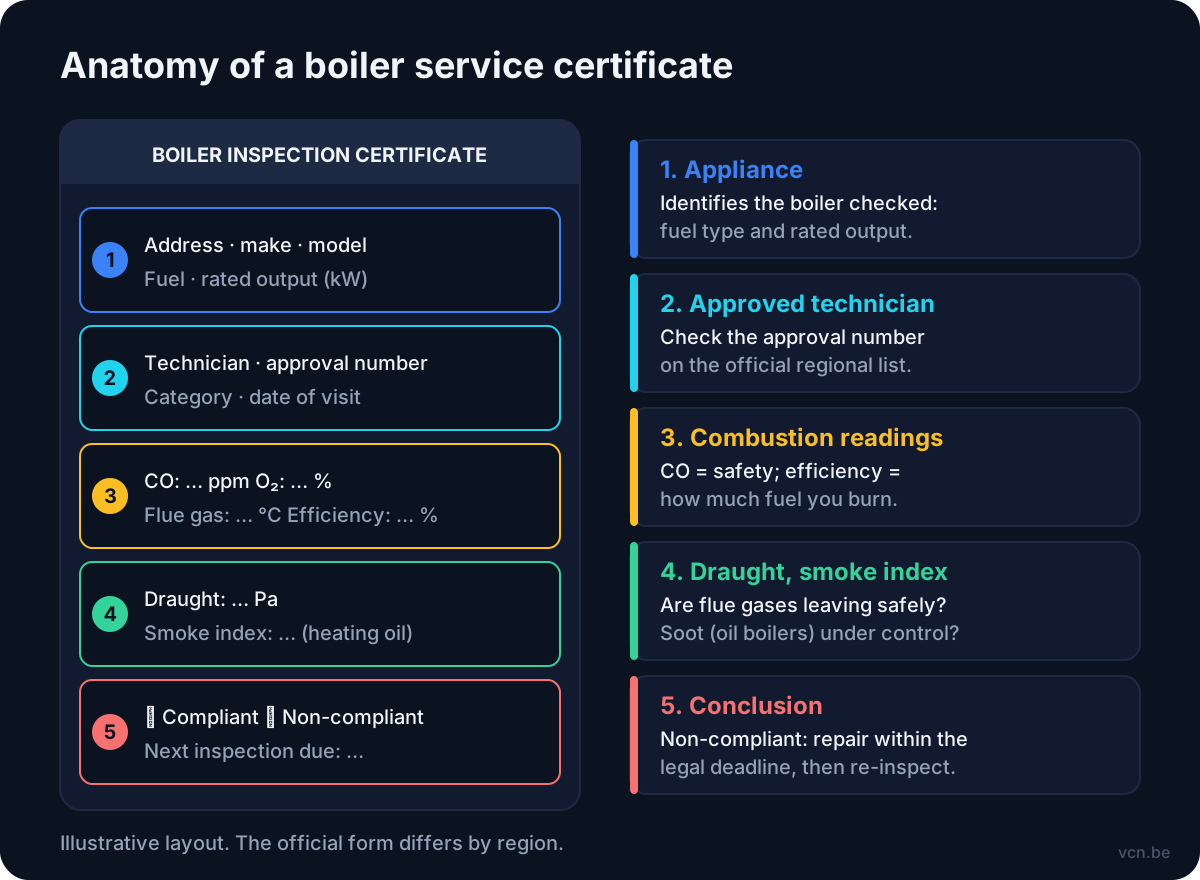
- The appliance: address, make, model, serial number, fuel and rated output in kW. Make sure it matches your boiler.
- The technician: name, approval number and category, date of the visit. You can check that number on the official list.
- Combustion readings: carbon monoxide (CO), oxygen (O2) or CO2, flue gas temperature and combustion efficiency. CO tells you about safety, efficiency about your fuel bill.
- Draught and smoke index: draught shows whether flue gases are leaving properly; the smoke index (oil boilers) measures soot.
- Conclusion: compliant or non-compliant, remarks, repair deadline and often the date of the next inspection.
A "non-compliant" result means a repair or adjustment within the legal deadline, then a new inspection. A high CO reading calls for immediate action: Brussels Environment records more than 120 carbon monoxide poisonings a year in Brussels alone. Our guide to gas leak detection and safety explains what to do.
How long should you keep the certificate?
In Flanders, the user and the owner keep at least the certificates of the last two services, next to the boiler, and the tenant gives the owner a copy. In Wallonia, the user keeps the last two certificates and the owner keeps the original commissioning and diagnosis reports.
In Brussels, the certificate is registered with Brussels Environment, but keep your PDF. Our advice, wherever you live: keep every certificate since installation, on paper and scanned, for insurance claims, a sale, the end of a lease or a warranty claim.
Tenant or landlord: who books and who pays?
The principle is the same in all three regions: routine servicing is a tenant's cost. Wallonia's official list of tenant repairs puts boiler servicing, the inspection by an approved technician, chimney sweeping and handing the certificate to the landlord on the tenant. The Brussels Region's guidance also lists boiler servicing and periodic inspection as the tenant's job, and so does Flemish rental law.
The landlord pays for parts that wear out normally, repairs due to age or faulty installation, and replacing the boiler. The landlord also arranges the commissioning check at installation and, in Wallonia, the in-depth diagnosis.
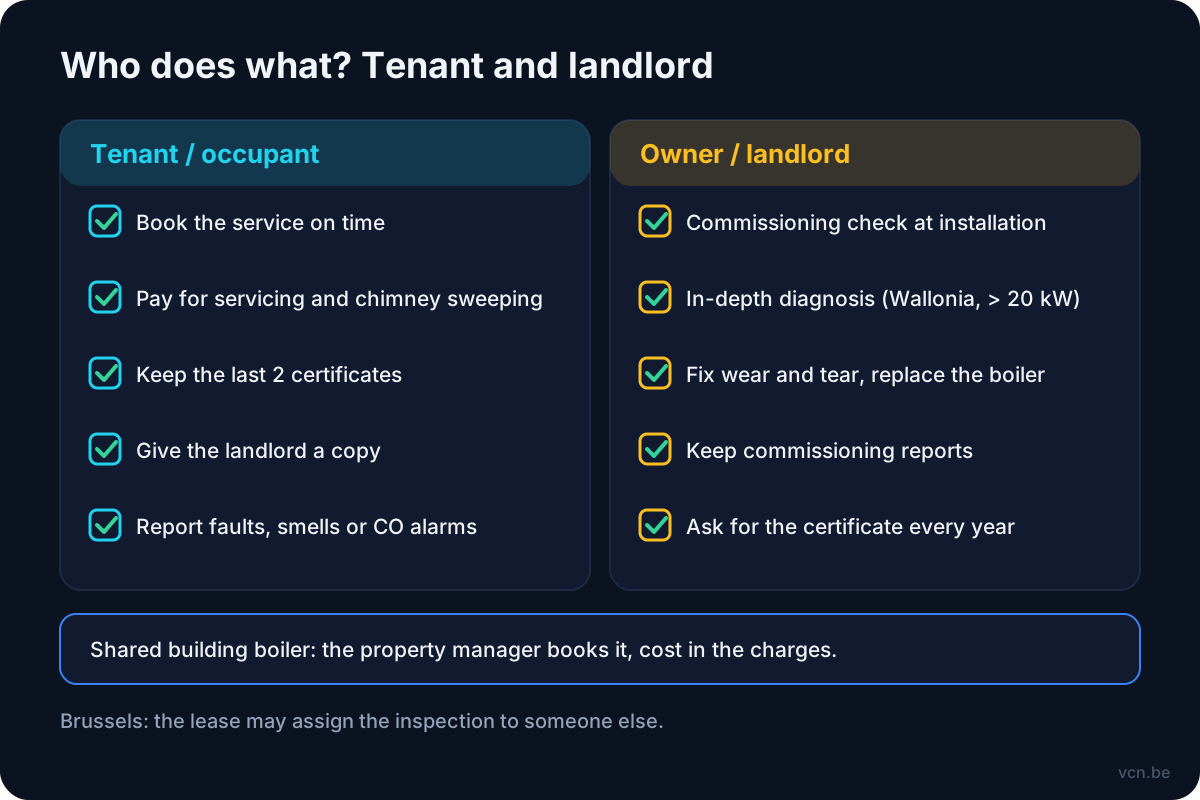
In an apartment building with a shared boiler, the syndic arranges servicing and the cost goes into the service charges. In Brussels, check your lease: it may assign the inspection to the landlord or the syndic.
Why does your insurer ask for the certificate?
After a fire, explosion or water damage linked to the heating, the insurer's loss adjuster almost always asks for the latest certificate. Yet Assuralia, the Belgian insurers' federation, states that fire insurance is not directly tied to the servicing obligation: most policies do not exclude damage caused by poor maintenance, so the insurer must pay out on a covered claim.
There are two important caveats. If the insurer finds that the fire resulted from negligence, it may cancel the policy after paying out or at renewal. And if your policy explicitly requires servicing, article 65 of the Belgian Insurance Act of 4 April 2014 allows cover to be forfeited when the obligation is written into the contract, the breach is proven and it caused the damage; the Court of Cassation confirmed this on 10 March 2025.
In short, the certificate is your best proof that poor maintenance did not cause the loss. Read the prevention clauses in your policy.
What about the manufacturer's warranty?
Manufacturers' commercial warranties often depend on professional servicing. For example, Viessmann Belgium's extended warranty terms require a maintenance contract, proof that the prescribed servicing took place and work carried out exclusively by a professional. Check your own warranty certificate, as terms differ between brands.
What are the penalties without a certificate?
In Brussels, a non-compliant owner risks an administrative fine and/or criminal penalty, and an occupant without a certificate a criminal penalty. In Wallonia, a non-compliant system must be fixed within 5 months; if the second inspection still fails, the boiler must be shut down, with limited tolerance for an occupied home during the heating season.
In Flanders, the Departement Omgeving treats missing certificates as an environmental infringement punishable by an administrative fine, and failing to service or repair as an environmental offence that can be prosecuted.
How do you choose an approved heating engineer?
- Check the approval on the official list: Brussels Environment's "Find a PEB professional" page, the AwAC list in Wallonia, or the GV and TV technician lists on Vlaanderen.be.
- Check the category: L for heating oil, G1/GI or G2/GII for gas depending on the burner, F-gas certification for a heat pump or air conditioner.
- Ask what is included: cleaning, combustion analysis, official certificate, chimney sweeping if needed, and call-out.
- Insist on the readings: a certificate with no CO or efficiency values, or without analyser tickets in Wallonia, is a red flag.
- Plan the next visit: note the due date or choose a contract with an automatic reminder.
How much does a service with certificate cost at VCN Energy?
In September 2026, VCN Energy lists these prices including VAT on vcn.be: gas boiler service €159, heating oil boiler €209, heat pump €205 and pellet boiler €240. To compare with the market, see our guide to boiler maintenance prices.
The VCN ONE plan includes the annual service, up to 20% off parts and call-outs, priority scheduling, priority breakdown response within 24/48 hours and an automatic reminder, with a one-year commitment and 2 months' notice. It costs €149, €189 or €239 a year for gas (Basic, Standard, Premium), €199, €249 or €349 for heating oil and €195, €259 or €379 for a heat pump.
The bottom line
Check the date on your last certificate: more than a year for heating oil or pellets, more than 2 years for gas in Brussels or Flanders, or 3 years in Wallonia, and you are overdue. File it with your insurance policy and, if you rent, send your landlord a copy.
VCN Energy works across Walloon Brabant, Brussels, Wallonia and part of nearby Flanders. You can book your service online, call 010 80 20 92 or email [email protected].
Frequently asked questions
Is an annual boiler service mandatory in Belgium?
Not always annual: it depends on the fuel and the region. Heating oil, wood and pellet boilers must be inspected every year in Brussels, Wallonia and Flanders. Gas boilers must be inspected every 2 years in Brussels and Flanders, and every 3 years in Wallonia up to 100 kW (every 2 years above that). In Flanders, the obligation applies to gas and oil boilers from 20 kW. Each inspection ends with an official certificate from an approved technician.
Who pays for the boiler service in a rented home in Belgium?
In Brussels, Wallonia and Flanders, routine boiler servicing and the periodic inspection are normally the tenant's responsibility and cost, and the tenant should give the landlord a copy of the certificate. The landlord pays for repairs due to normal wear or age, replaces the boiler when needed and arranges the commissioning check at installation. In Brussels, the lease may assign the inspection to someone else, such as the landlord or the syndic.
Can my home insurer refuse to pay without a boiler service certificate?
Not automatically. According to Assuralia, most Belgian fire policies do not exclude damage caused by poor maintenance, so the insurer must pay a covered claim, although it may cancel the policy for negligence. If your policy explicitly requires servicing, article 65 of the Insurance Act of 4 April 2014 allows cover to be forfeited when the breach is proven and caused the damage. A recent certificate is therefore your best protection.
How long should I keep a boiler service certificate in Belgium?
The minimum is the last two certificates: Wallonia requires this of the user, and Flanders of both the user and the owner, kept next to the boiler. In Brussels, the certificate is registered digitally with Brussels Environment, but keep your PDF copy. In practice, keep every certificate since installation, as they are useful after an insurance claim, when selling the property, at the end of a lease or for a warranty claim.
Is heat pump maintenance mandatory in Belgium?
A heat pump has no combustion inspection, but its refrigerant is covered by EU F-gas Regulation 2024/573. A leak check by a certified technician is required from 5 tonnes of CO2 equivalent per circuit, or 10 tonnes for hermetically sealed and labelled equipment; many small units fall below this. In Brussels, heat pumps above 12 kW also need a PEB acceptance check. An annual service is still recommended for efficiency and the warranty.
How can I check that a heating engineer is approved?
Ask for the approval number and look it up on your region's official list: Brussels Environment's "Find a PEB professional" page for PEB boiler technicians, the AwAC list of approved heating technicians in Wallonia, or the lists of gaseous fuel (GV) and liquid fuel (TV) technicians on Vlaanderen.be. Also check the category: L for heating oil, G1/GI or G2/GII for gas. The number should appear on your certificate.
Sources
- Contrôle périodique PEB : entretien obligatoire de votre chaudière — Brussels Environment
- Heating and air conditioning: mandatory PEB inspections — Brussels Environment
- Heating and air conditioning: PEB requirements — Brussels Environment
- Heat pumps, air conditioning and refrigeration equipment — Brussels Environment
- Find a PEB professional — Brussels Environment
- Carbon monoxide: preventing poisoning — Brussels Environment
- Division of repairs between tenant and landlord — be.brussels
- Walloon Government decree of 29 January 2009 (consolidated) — Wallex
- PEB heating regulation in Wallonia — Energie Plus (UCLouvain / SPW)
- Non-exhaustive list of tenant repairs — Walloon Public Service, Housing
- Heating appliance in use: periodic servicing — Departement Omgeving (Flanders)
- Recognition as a gaseous or liquid fuel technician — Vlaanderen.be
- Heating audit for fossil fuel boilers no longer mandatory — Techlink
- Must the insurer pay without an annual heating check? — Assuralia
- Forfeiture of cover: Court of Cassation, 10 March 2025 — Legalex
- Heating warranties — Viessmann Belgium
- Regulation (EU) 2024/573 on fluorinated greenhouse gases — EUR-Lex