Heat Pump
Heat pump in an old house: keep or replace the radiators?
Switching an older Belgian house to a heat pump does not mean replacing every radiator. The 55 °C test, heat loss calculation, low-temperature radiator output, insulation priorities and a worked example.
· 11 min read · L'équipe technique VCN Energy
In a Belgian house built in the 1970s or 1980s, you do not automatically need to replace every radiator to switch to a heat pump. The original systems were designed for water at 70-90 °C, usually with a generous margin, so if the house has been partly insulated since, many radiators still cope at 50-55 °C. The right order: insulate the roof and seal air leaks, run the "55 °C test" this winter, have the heat loss calculated room by room, then replace only the radiators that are too small.
Why flow temperature decides everything
The flow temperature is the temperature of the water leaving the boiler or heat pump towards the radiators. In a 1970s-80s Belgian house, the original oil boiler (mazout in French, stookolie in Dutch) or gas boiler typically ran at 70 to 90 °C, the classic radiator regime according to Energie+, the technical portal of UCLouvain and the Walloon administration.
An air-to-water heat pump extracts heat from outdoor air and "lifts" it to the water temperature: the bigger the lift, the more electricity the compressor uses.
That is why the EU energy labelling rules (Delegated Regulation (EU) No 811/2013) define two reference points: the low-temperature application (water at 35 °C) and the medium-temperature application (water at 55 °C). Every heat pump product sheet therefore shows two seasonal efficiency figures.
COP and SCOP: reading a datasheet properly
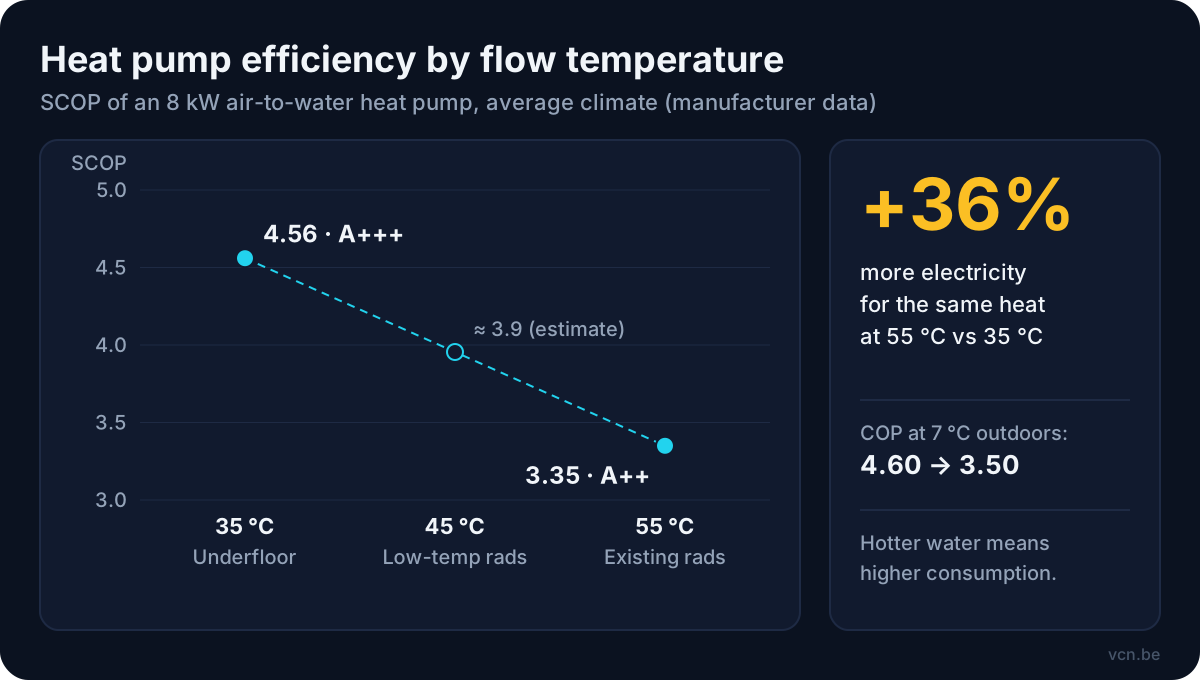
COP is a snapshot measured under fixed conditions, for example A7/W35 (7 °C outside, water at 35 °C). SCOP is the average efficiency over a whole heating season and says far more about your bill. Example from a manufacturer's catalogue (Daikin Altherma 3 R, 8 kW, average climate):
| Flow temperature | SCOP | Energy class | COP at 7 °C outdoors |
|---|---|---|---|
| 35 °C (underfloor heating, large radiators) | 4.56 | A+++ | 4.60 |
| 45 °C (low-temperature radiators) | ≈ 3.9 (interpolated) | – | – |
| 55 °C (existing radiators) | 3.35 | A++ | 3.50 |
At 55 °C, the same amount of heat needs roughly 36% more electricity than at 35 °C with this unit (the 45 °C value is our estimate, not a catalogue figure). Always compare quotes at the same flow temperature.
The 55 °C test: are your radiators already good enough?
In the Netherlands, the public agency Milieu Centraal popularised the "50-degree test", and several manufacturers active in Belgium recommend it too: run your current boiler at a low temperature during a cold spell and see whether the house stays comfortable.
We suggest starting at 55 °C. It matches the medium-temperature point of the EU energy label and the maximum emission temperature required for the Flemish heat pump grant. If all is well at 55 °C, repeat the test at 50 °C.
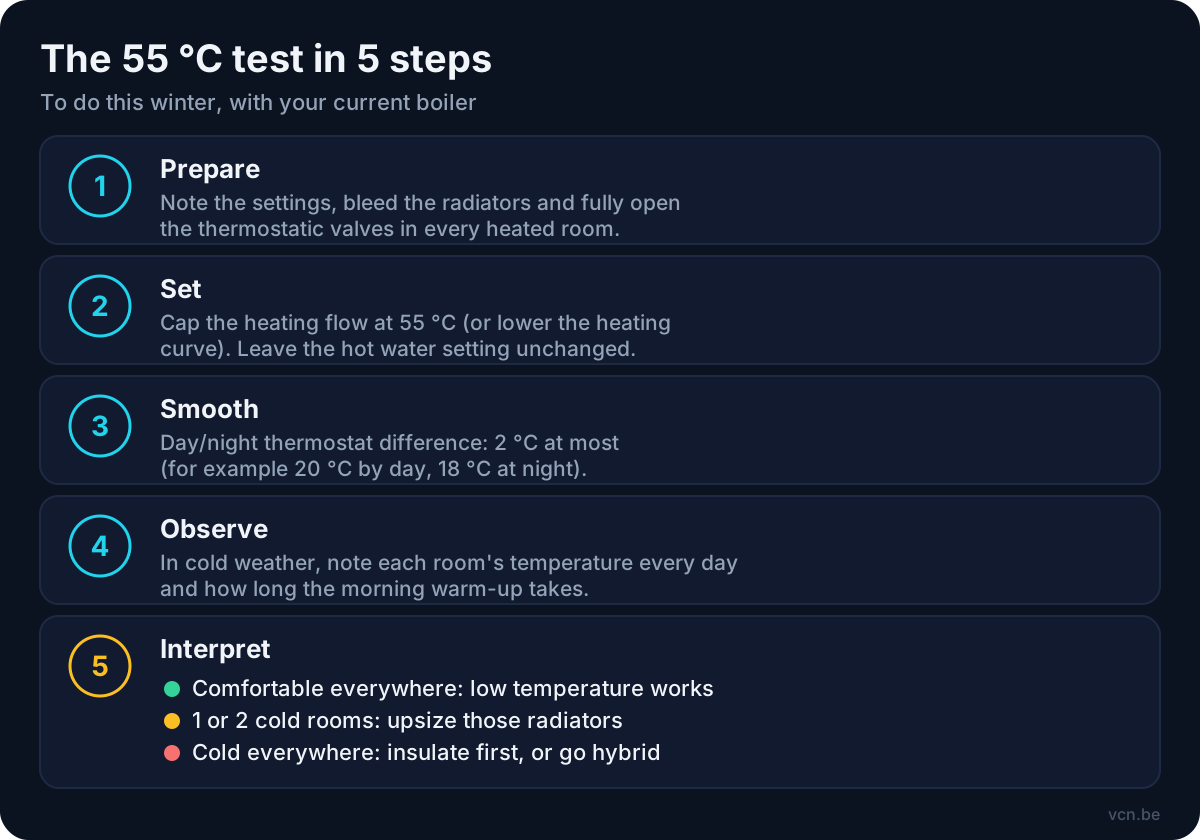
- Prepare. Write down the boiler's current settings, bleed the radiators and fully open the thermostatic valves in every heated room.
- Set. Cap the heating flow temperature at 55 °C (or lower the heating curve so it never exceeds 55 °C). Do not touch the domestic hot water setting.
- Smooth. Keep the day/night thermostat difference to 2 °C at most (for example 20 °C by day, 18 °C at night), as Milieu Centraal advises: at low temperature, the house warms up more slowly in the morning.
- Observe. In cold weather, note each day the temperature reached in every room, how long the morning warm-up takes and which rooms stay chilly.
- Interpret. Comfortable everywhere: low-temperature heating is realistic. One or two cold rooms: those radiators need upsizing or replacing. Cold everywhere: insulate first, or consider a hybrid system.
If you heat with gas, Milieu Centraal also suggests reading the meter 24 hours apart on a day at −5 °C or colder: convert the m³ to kWh (the factor is on your bill) and divide by 24 to get a rough idea of the output your house really needs.
Heat loss and radiator output: the calculation settles it
The test gives a trend; the calculation gives the answer. Buildwise, the Belgian construction research centre formerly known as CSTC/WTCB, recommends calculating the heat load room by room under NBN EN 12831-1 and its 2020 Belgian national annex, for example with its HeatLoad tool.
Buildwise warns against two shortcuts: old watts-per-square-metre tables, and deducing heat loss from the existing radiators, which are usually oversized. A proper calculation starts from the walls, windows, airtightness and the local outdoor design temperature (−8 °C in Brussels Environment's worked examples).
The output factor at low temperature
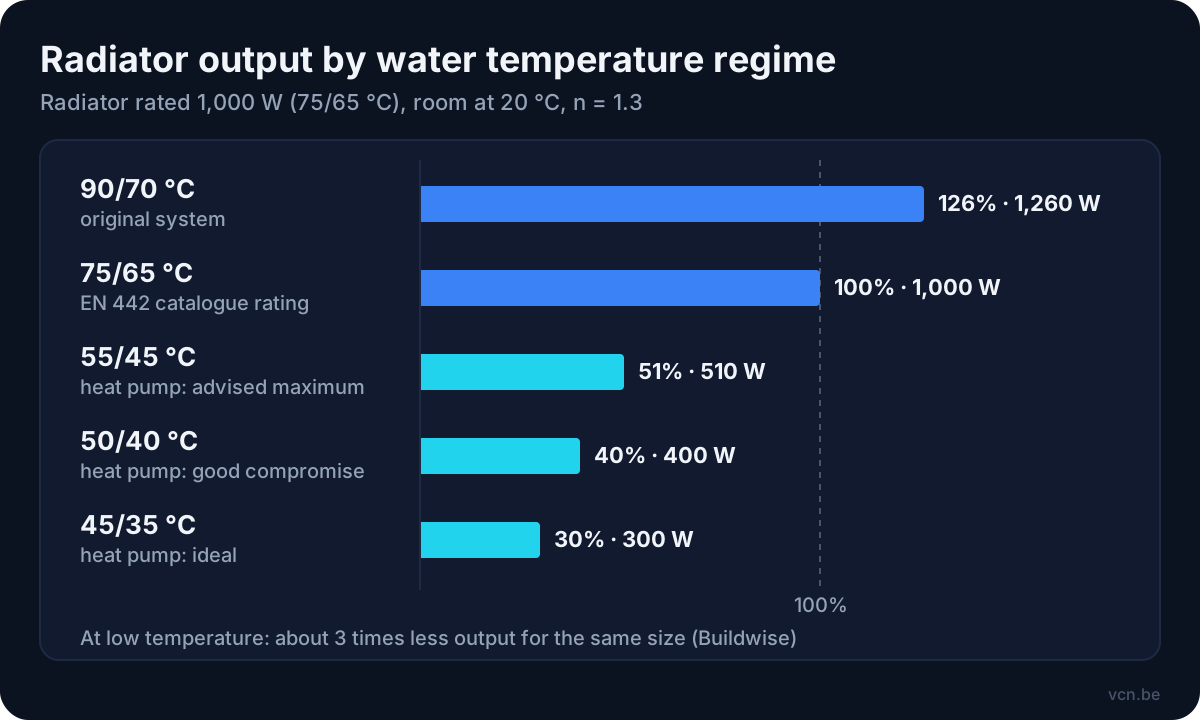
A radiator's catalogue output is measured under the EN 442 standard at a 75/65 °C regime in a 20 °C room. What matters is ΔT, the gap between the average water temperature and the room: output scales with (actual ΔT / rated ΔT) to the power n, with n ≈ 1.3 for most radiators.
| Regime (flow/return) | Mean ΔT (room at 20 °C) | Output vs 75/65 catalogue | A "1,000 W" radiator |
|---|---|---|---|
| 90/70 °C (original system) | ≈ 59 K | 126% | ≈ 1,260 W |
| 75/65 °C (EN 442 reference) | ≈ 50 K | 100% | 1,000 W |
| 55/45 °C | ≈ 30 K | 51% | ≈ 510 W |
| 50/40 °C | ≈ 25 K | 40% | ≈ 400 W |
| 45/35 °C | ≈ 20 K | 30% | ≈ 300 W |
Calculated by VCN Energy using the EN 442 method (logarithmic mean temperature difference, n = 1.3). Buildwise sums it up: at low temperature, a radiator of the same size delivers about three times less heat than at high temperature.
So a radiator chosen for 90/70 °C keeps only about 41% of its original output at 55/45 °C. But heat demand has often fallen since (double glazing, insulated roof) and the original system was rarely sized tightly: the room-by-room calculation checks that double margin.
Hydraulics matter too: a heat pump often runs with a 5 K flow/return difference and, as Buildwise notes, a smaller ΔT requires a higher flow rate. Check pipes, pump and balancing; in a 40-year-old circuit, power flushing first is good insurance.
Which radiators to keep, which to replace?
- Usually worth keeping: wide steel panel radiators (types 22 or 33) and large cast-iron radiators, if the calculation confirms they can heat the room.
- Replace or supplement: short radiators in the living room (large windows) and in bathrooms, which are designed for 24 °C.
- Low-temperature radiators: designed to deliver enough heat at 45-55 °C. Brussels Environment defined them, for its former grants, as working at 55/45 °C maximum. See our page on low-temperature radiators.
- Fan convectors: a fan boosts heat transfer, so a compact unit works at low temperature, sometimes with summer cooling. One manufacturer puts them at about €900 to €1,400 per room, VAT included.
- Radiator fans ("boosters"): according to Energie+, they realistically compensate a 10 to 15 °C drop in regime, no more.
Insulation: where to start?
Every kW of heat loss you remove shrinks both the heat pump size and the flow temperature you need, which is often better value than replacing every radiator.
Homegrade, the Brussels housing advice centre, puts it simply: "start at the top", because the roof is where most heat escapes. Walls come next (almost a quarter of losses), then the floor above the cellar (about 15%), windows and ventilation.
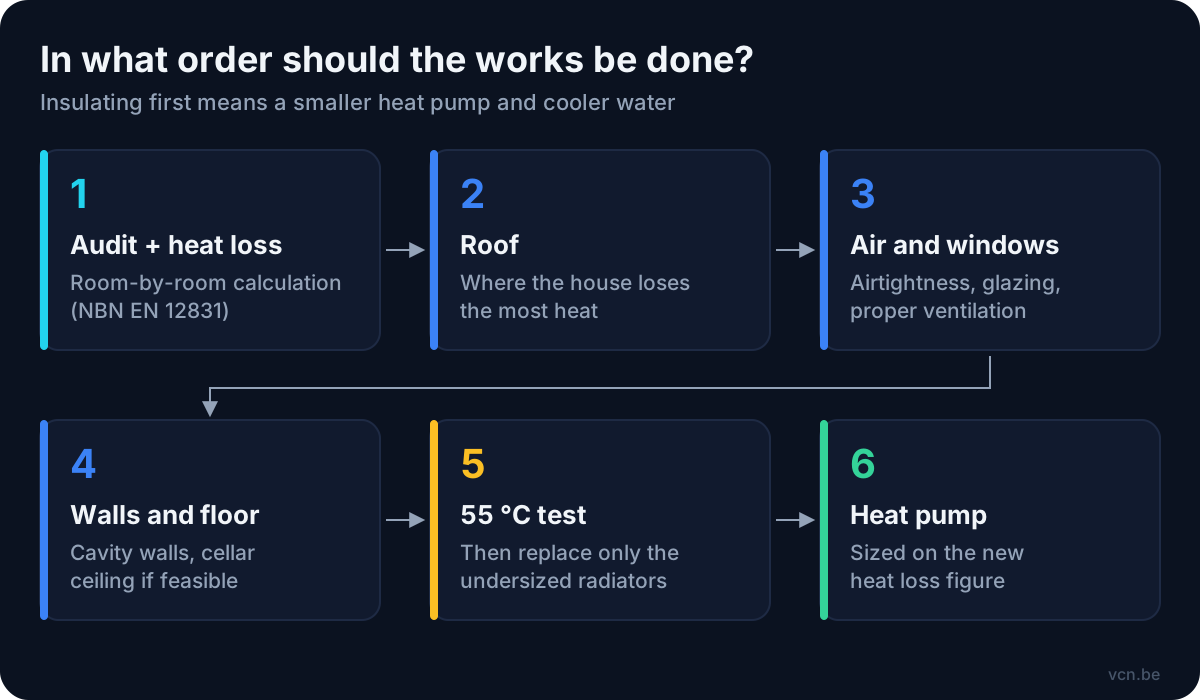
- Energy audit and heat loss calculation: see our page on the energy audit and EPC (the PEB/EPB certificate in Belgium).
- Roof or loft floor.
- Airtightness and windows, with proper ventilation.
- Cavity walls and cellar ceiling, where feasible.
- 55 °C test, then targeted radiator replacement.
- Heat pump sized on the new heat loss.
Low-temperature, high-temperature or hybrid heat pump?
| Option | Flow temperature | When it makes sense | Watch out for |
|---|---|---|---|
| Low-temperature air-to-water heat pump | 35 to 55 °C | Insulated house, radiators adequate or partly replaced | Best efficiency; needs a real heat loss study |
| High-temperature air-to-water heat pump | 60-70 °C, up to 70-75 °C for some propane (R290) units | Radiators cannot be changed, limited insulation | Much lower efficiency; Energie+ puts the sensible limit around 50 °C |
| Hybrid heat pump (heat pump + boiler) | Heat pump at low temperature, boiler for peaks | House not ready yet, works spread over years | Two appliances to service; a transition step |
According to Energie+, a hybrid heat pump sized at about 30% of peak output covers roughly 70% of annual heat demand, and about 90% at 60% of peak output, with the boiler covering the rest. The Flemish government's heat pump action plan also treats hybrids as a transition measure for homes that are not yet heat-pump ready.
More detail on our pages on hybrid heat pumps and air-to-water heat pumps.
The most common sizing mistakes
- Copying the old boiler's output. Brussels Environment warns that an oversized heat pump does not run optimally (short cycling, wear, extra cost).
- Sizing per square metre or from the radiators, which Buildwise explicitly advises against.
- Sizing before insulating: insulate the roof a year later and the heat pump is too big.
- Ignoring hydraulics: too little flow or a sludged circuit, and the heat never reaches the radiators.
- Keeping boiler habits: big night setbacks, a badly set heating curve.
- Forgetting domestic hot water: the cylinder and its priority weigh on the required output.
Worked example: a 1978 detached house in Walloon Brabant
This example is illustrative: plausible ranges, not the result of a study. Only an NBN EN 12831 calculation of your own house counts.
The house: 150 m² heated, empty cavity walls, 1990s double glazing, 6 cm of mineral wool in the roof, a 29 kW oil boiler, original steel radiators totalling 20 to 22 kW at 90/70 °C.
| Before works | After roof, airtightness and cavity walls | |
|---|---|---|
| Heat loss at design temperature | 14 to 16 kW | 8 to 10 kW |
| Existing radiators at 55/45 °C (≈ 41% of 90/70) | 8 to 9 kW | 8 to 9 kW |
| 55 °C test | Fails in hard frost | Comfortable almost everywhere |
| Radiators to replace | Most of them | 2 or 3 (living room, bathroom) |
| Solution | Hybrid (4 to 6 kW heat pump + boiler) | 8 to 10 kW air-to-water heat pump |
With a heat demand of 12,000 to 15,000 kWh a year after the works, a SCOP of 3.35 (55 °C flow) means roughly 3,600 to 4,500 kWh of electricity a year; a SCOP of 4.56 (35 °C flow), roughly 2,600 to 3,300 kWh. Lowering the flow temperature saves several hundred kWh every year.
For budgeting, Brussels Environment gave €7,000 to €11,000 in 2025 for an air-to-water heat pump without hot water production and €8,000 to €13,000 with it, for a 120 m² home. See our guide to heat pump installation prices and current electricity prices for heat pumps.
Grants in September 2026: what applies where?
The situation on 23 September 2026; amounts are detailed in our guide to heat pump subsidies in Belgium.
- Wallonia: the current Primes Habitation scheme ends on 30 September 2026 (works finished and application filed by then). From 1 October 2026, Rénopack (a 0% loan with part of the amount written off) and Rénoprêt take over, with a mandatory prior energy audit.
- Brussels: Renolution grants are suspended, with no government decision on new support.
- Flanders: the Mijn VerbouwPremie for heat pumps continues, with a maximum emission temperature of 55 °C and a RESCert-certified installer; amounts for higher incomes were cut on 1 March 2026.
- VAT: for a home over 10 years old, renovation work generally qualifies for the reduced 6% rate (conditions apply); the temporary 6% rate for 2026-2030 targets homes under 10 years old.
Our advice as heating engineers
The real question is not "should I change my radiators?" but "at what temperature can my house be heated?". Insulate what is easy first, run the 55 °C test this winter, have the heat loss calculated, then replace only the radiators that hold you back.
VCN Energy carries out this assessment and the installation across Walloon Brabant, Brussels and Wallonia: book online, call 010 80 20 92 or email [email protected].
Frequently asked questions
Can a heat pump work with old cast-iron radiators?
Yes, if their output is sufficient at the chosen flow temperature. Large cast-iron radiators in older Belgian houses often have a generous surface, but like any radiator they deliver only about half their rated output at a 55/45 °C regime. The 55 °C test and a room-by-room heat loss calculation show whether they can stay or need supplementing.
What flow temperature should a heat pump use with radiators?
Ideally 45 to 50 °C in hard frost, and 55 °C at most. For one 8 kW air-to-water heat pump, the SCOP drops from 4.56 at 35 °C to 3.35 at 55 °C, about 36% more electricity for the same heat. The Flemish heat pump grant also requires an emission temperature of 55 °C maximum. If you need hotter water, a hybrid is often wiser.
Do I need to insulate before installing a heat pump in an old house?
It is strongly recommended. Brussels Environment presents insulation as a prerequisite: it allows low-temperature heating with a smaller, cheaper heat pump. Start with the roof, where most heat escapes, then airtightness and windows. Sizing the heat pump before these works leads to an oversized unit.
How do I know if my house is ready for a heat pump?
Run the 55 °C test: in cold weather, cap your boiler's flow temperature at 55 °C, fully open all thermostatic valves and keep the day/night difference to 2 °C. If every room stays comfortable, your house is probably suitable. Then confirm it with a heat loss calculation under NBN EN 12831, carried out by a professional heating engineer.
Is a hybrid heat pump a good option for an older house?
Yes, as a stepping stone. According to Energie+, a heat pump sized at about 30% of peak output covers roughly 70% of annual heat demand, with the boiler handling the coldest days. It suits owners spreading insulation work over several years or unable to replace some radiators. The Flemish heat pump action plan treats hybrids as a transition measure.
What size heat pump for a 150 m² house from the 1970s?
No per-square-metre rule is reliable: Buildwise advises against old W/m² tables. As an illustration, a 150 m² detached house may lose 14 to 16 kW before works and 8 to 10 kW after insulating the roof and cavity walls and sealing air leaks. The output must come from a room-by-room calculation, never from the old boiler's rating.
Sources
- Émission de chaleur à basse et très basse température (FR) — Buildwise
- Déperditions calorifiques - charge thermique (FR) — Buildwise
- Innovation Paper 53: Le défi des pompes à chaleur en rénovation (2025, FR) — Buildwise
- Pompe à chaleur et haute température (FR) — Energie+ (UCLouvain, SPW)
- Choisir l'émetteur de chaleur d'une PAC (FR) — Energie+ (UCLouvain, SPW)
- La pompe à chaleur : une solution d'avenir (FR) — Brussels Environment
- Besoins et exigences pour le dimensionnement d'une installation de chauffage (FR) — Brussels Environment
- Les primes RENOLUTION (FR) — Brussels Environment
- Isolation thermique d'une maison bruxelloise (FR) — Homegrade
- Gouvernement wallon du 16 juillet 2026 (FR) — Wallonie.be
- Primes Habitation : fin du régime temporaire le 30 septembre 2026 (FR) — UVCW
- Mijn VerbouwPremie voor warmtepomp (NL) — Vlaanderen.be
- Visienota Actieplan Warmtepompen 2030 (NL) — Flemish Government
- Commission Delegated Regulation (EU) No 811/2013 — EUR-Lex
- Circulaire 2026/C/19 on the reduced VAT rate for heat pumps (FR) — ITAA/OECCBB blog
- Hoe werkt de Verwarmingstest? (NL) — Milieu Centraal
- Daikin Altherma 3 R product catalogue 2022 — Daikin
- Combiner une pompe à chaleur avec des radiateurs (FR) — Vaillant Belgium
- Correction factors (Delta T conversion) — Zehnder