Heat Pump
Heat pump winter settings: defrost, noise and 7 mistakes
Autumn checklist, defrosting, heating curve, hot water, backup heater, noise, F-gas rules and normal consumption: everything to get your heat pump ready before the cold.
· 11 min read · L'équipe technique VCN Energy
The best heat pump winter settings keep the flow temperature as low as possible through a well-tuned heating curve, avoid switching the unit off at night and keep the electric backup heater for severe cold only. Before the first frost, clear the outdoor unit, check the condensate drain, filters and water pressure, and book the annual service. Steam and short defrost pauses are normal.
Autumn checklist: what should you check before winter?
Done in October, these checks prevent many January breakdowns. Tenants should check their lease to see who books the annual service.
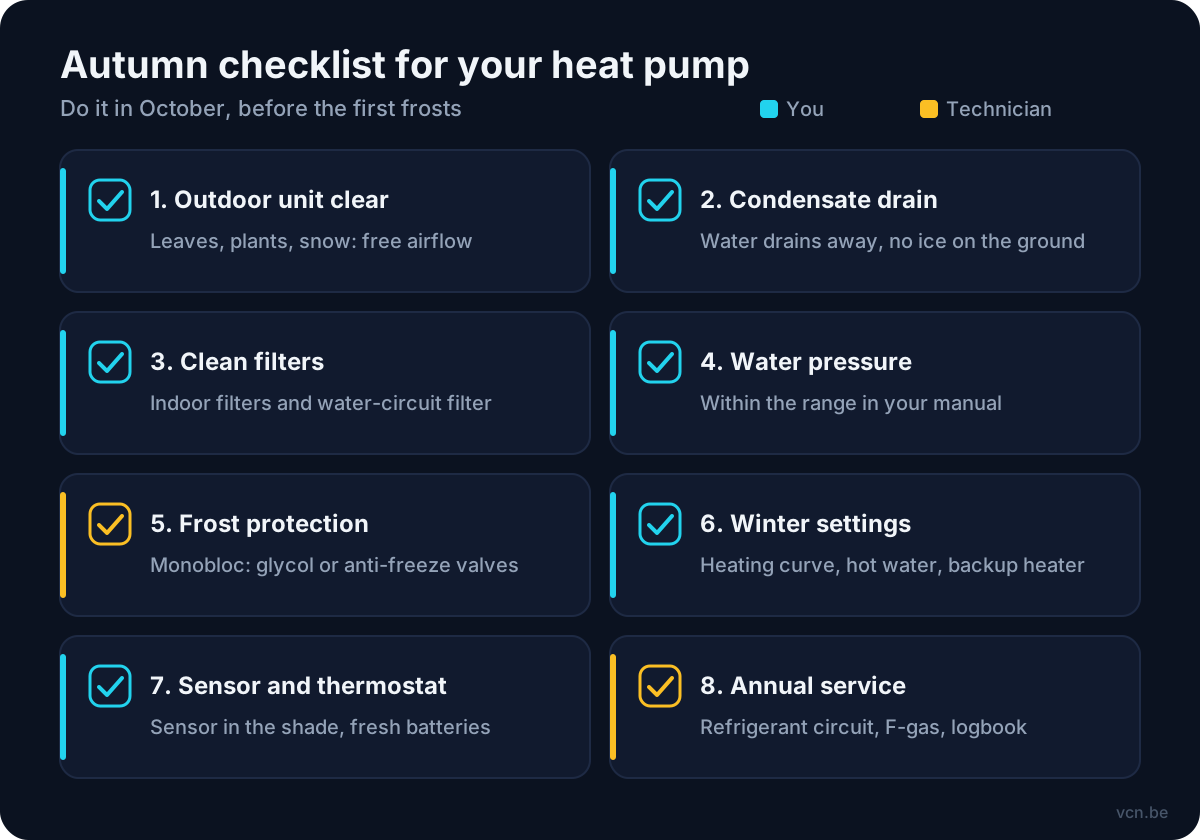
- Clear the outdoor unit: leaves, climbing plants, bikes or bins stored against the wall. Viessmann recommends at least 25 cm of free space behind the unit.
- Check the condensate drain: water must run away rather than pool under the unit.
- Clean the filters: indoor-unit filters on an air-to-air system, or the dirt filter in the water circuit on an air-to-water system (often a job for the technician).
- Read the water pressure on the gauge and compare it with the range your installer gave you. Pressure that keeps dropping points to a leak or an expansion vessel problem; see our guide to heating pressure problems.
- Have the frost protection checked if you have a monobloc unit (see below).
- Review your winter settings: heating curve, hot water, backup heater.
- Check the outdoor sensor: it must measure the air, not the sun. Replace the batteries of a wireless thermostat.
- Book the annual service before the December rush.
Daikin recommends a canopy against snow in cold regions; a cover or a closed box, on the other hand, suffocates the unit. After snowfall, brush the unit clear without scraping the fins.
Condensate: watch out for ice
The unit releases water, especially during defrost. NIBE warns that this water can freeze under the unit and that heavy ice build-up can cause damage not covered by the warranty. Daikin also advises against fitting a drain hose in cold regions, because the water can freeze inside it. Gravel bed, drip tray or trace heating: the right answer depends on the installation.
Glycol and anti-freeze valves: mainly for monobloc units
In a monobloc heat pump, the heating water flows right into the outdoor unit. As long as the unit has power, its controls protect the water from freezing. The risk comes with a power cut in freezing weather: as Caleffi points out, electric trace heating stops working without electricity.
There are two safeguards: glycol (anti-freeze) mixed into the water, whose concentration the technician measures, or anti-freeze valves that drain the pipe when the water drops to about 3 °C (such as Caleffi's series 108). A split heat pump, whose water circuit stays indoors, is far less exposed.
Defrosting: why the steam and the pauses?
In cold, damp weather the outdoor coil frosts over. According to Mitsubishi Electric, this happens mainly between −4 °C and +4 °C, and more in humid locations. The heat pump then briefly reverses its cycle, sending heat back to the outdoor unit to melt the frost. Energie Plus, backed by the Walloon government, confirms that defrosting takes priority and starts automatically.
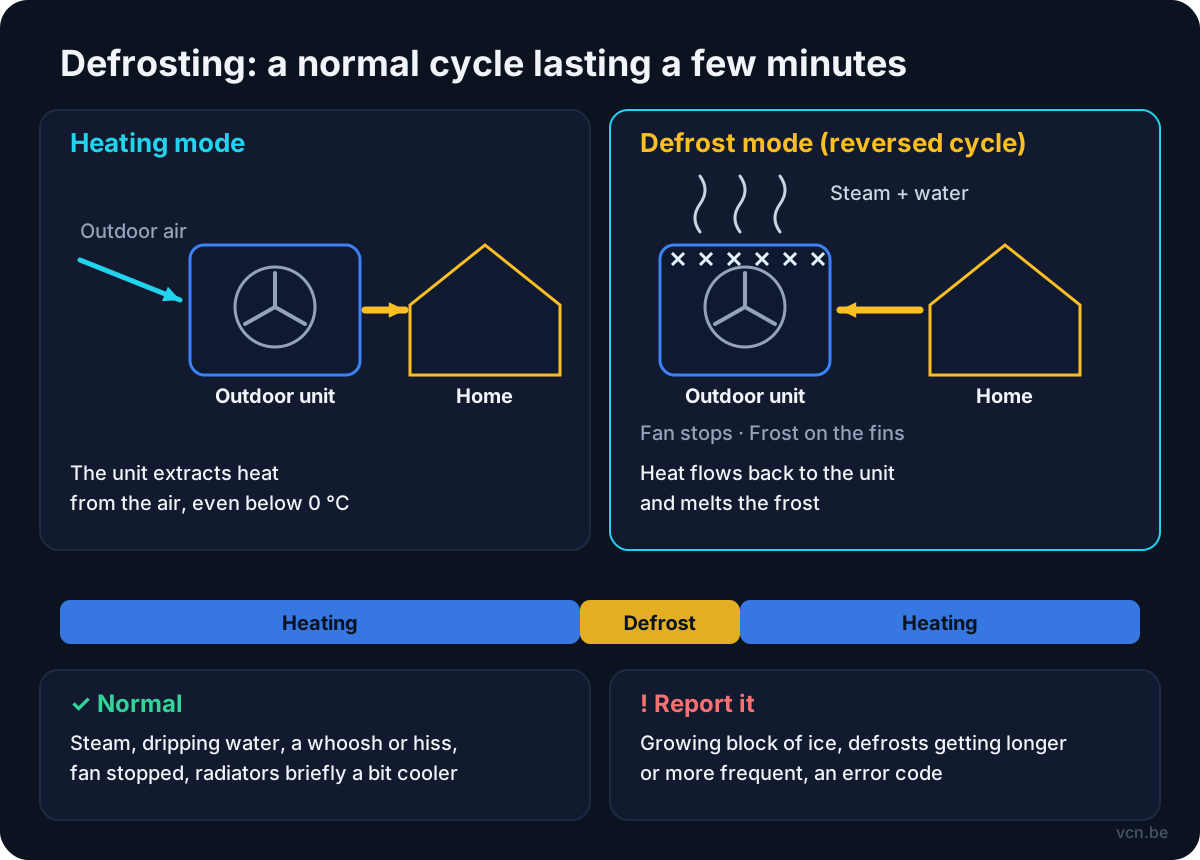
During those few minutes (3 to 6 minutes on Mitsubishi Electric's fast models; Trane quotes 3 to 5 minutes), it is normal to see:
- a cloud of steam, which Daikin explicitly describes as normal;
- water running out under the unit;
- the fan stopping and a whooshing sound as the cycle reverses;
- radiators feeling slightly cooler for a short while.
Not normal: a block of ice growing day after day, defrosts getting longer or more frequent, or an error code. Call a technician.
Which heat pump settings work best in winter?
A heat pump uses less electricity when the water is cooler. Vaillant recommends a flow temperature of 40 °C at most; Daikin ideally aims for 35 °C or less. Underfloor heating needs less than low-temperature radiators.
Heating curve and flow temperature
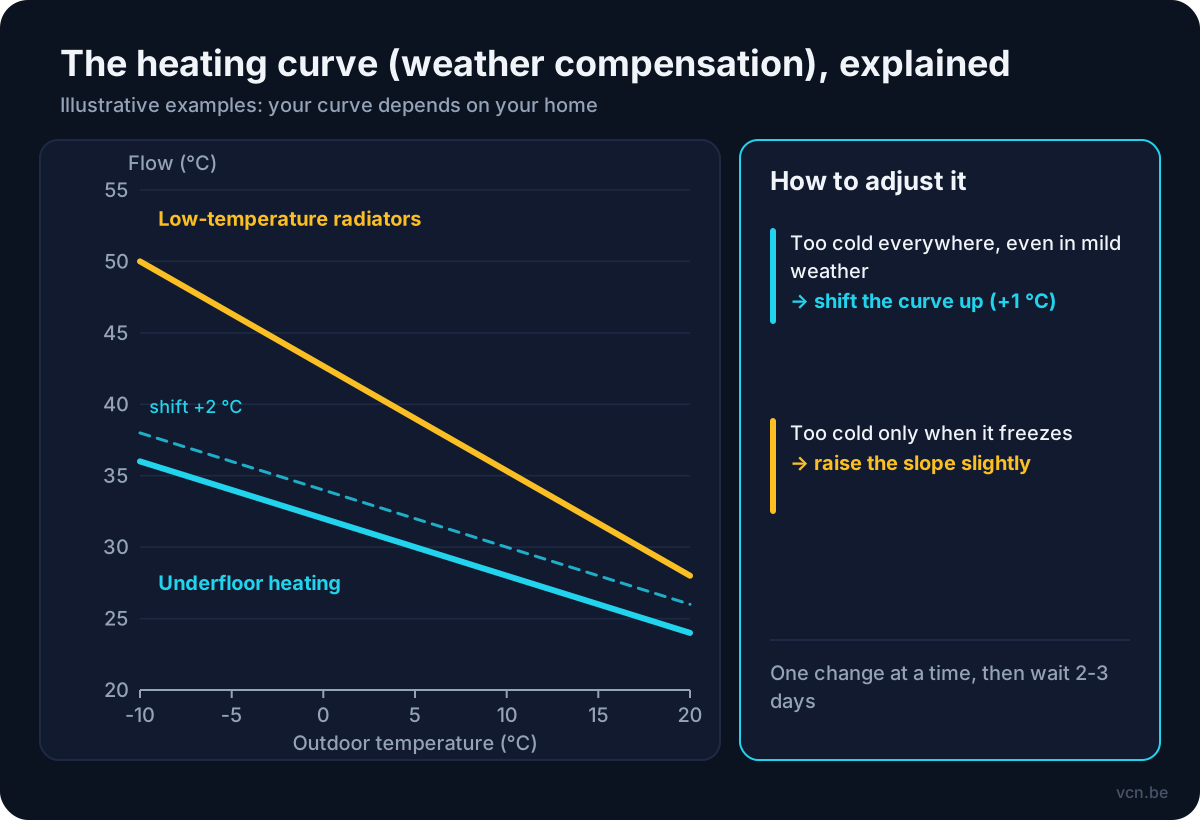
The heating curve (weather compensation, courbe de chauffe in French, stooklijn in Dutch) sets how hot the water sent to your heating is, based on the outdoor temperature. The curve, not a thermostat turned right up, is what delivers comfort.
- Write down the installer's setting before changing anything.
- Too cold everywhere, even in mild weather: shift the curve up by about 1 °C.
- Too cold only when it freezes: raise the slope slightly.
- Too warm: do the opposite. The Energy Saving Trust suggests lowering it one degree at a time.
- Wait two to three days between changes, especially with underfloor heating.
Our smart thermostat page explains which controls suit a heat pump.
Night setback: should you turn it down at night?
Switching a heat pump off at night is a false economy: it restarts with much hotter water, at lower efficiency, and the backup heater may kick in. Daikin recommends a stable temperature, no lower than around 18 °C at night. The Energy Saving Trust accepts a setback of a few degrees. Our advice: 1 to 2 °C at most with radiators, little or no setback with underfloor heating.
Domestic hot water and legionella
Legionella bacteria multiply between 25 and 45 °C; at 60 °C, 90% die within 5 minutes (Energie Plus). The Sustainable Building Guide of Brussels Environment (Bruxelles Environnement, the regional environment agency) recommends producing hot water at 60 °C. Yet holding 60 °C permanently costs a heat pump a lot of efficiency.
The usual compromise: a cylinder at around 50-55 °C plus an anti-legionella cycle above 60 °C at regular intervals; the Energy Saving Trust considers a weekly cycle enough in most cases. Schedule it away from the morning showers.
Backup heater: keep it under control
The electric backup heater (immersion or inline heater) turns 1 kWh of electricity into 1 kWh of heat, whereas the heat pump delivers several. Energie Plus recommends manual activation to avoid excessive running time; Daikin keeps it for extreme cold. Ask your technician at which outdoor temperature it switches on. To estimate the cost, see our electricity prices for heat pumps.
Noise and neighbours: what are the rules in Belgium?
Winter means longer night-time running, and the rules differ by region.
| Region | What applies (September 2026) |
|---|---|
| Brussels | Orders of 21 November 2002 (neighbourhood noise, classified installations): dB(A) limits by zone and time period, night being the strictest |
| Wallonia | To our knowledge, no decibel limit specific to domestic heat pumps; no planning permit needed since 1 May 2025 if the unit is 3 m from the boundaries and not visible from the street |
| Flanders | VLAREM noise standards only for classified heat pumps, which most domestic units are not (Flemish Department of Environment) |
| Everywhere | Civil Code, Article 3.101: no nuisance beyond the normal inconveniences between neighbours |
Brussels Environment noted in April 2026 that sound levels drop by about 6 dB each time the distance doubles, and rise by about 3 dB for each nearby hard surface (ground, wall, corner). Corners and inner courtyards, common in Brussels townhouses, amplify noise.
In winter, switch on the quiet or night mode if your model has one, and have the anti-vibration mounts and fan checked if a new noise appears: it is often a mechanical symptom.
7 common heat pump mistakes in winter
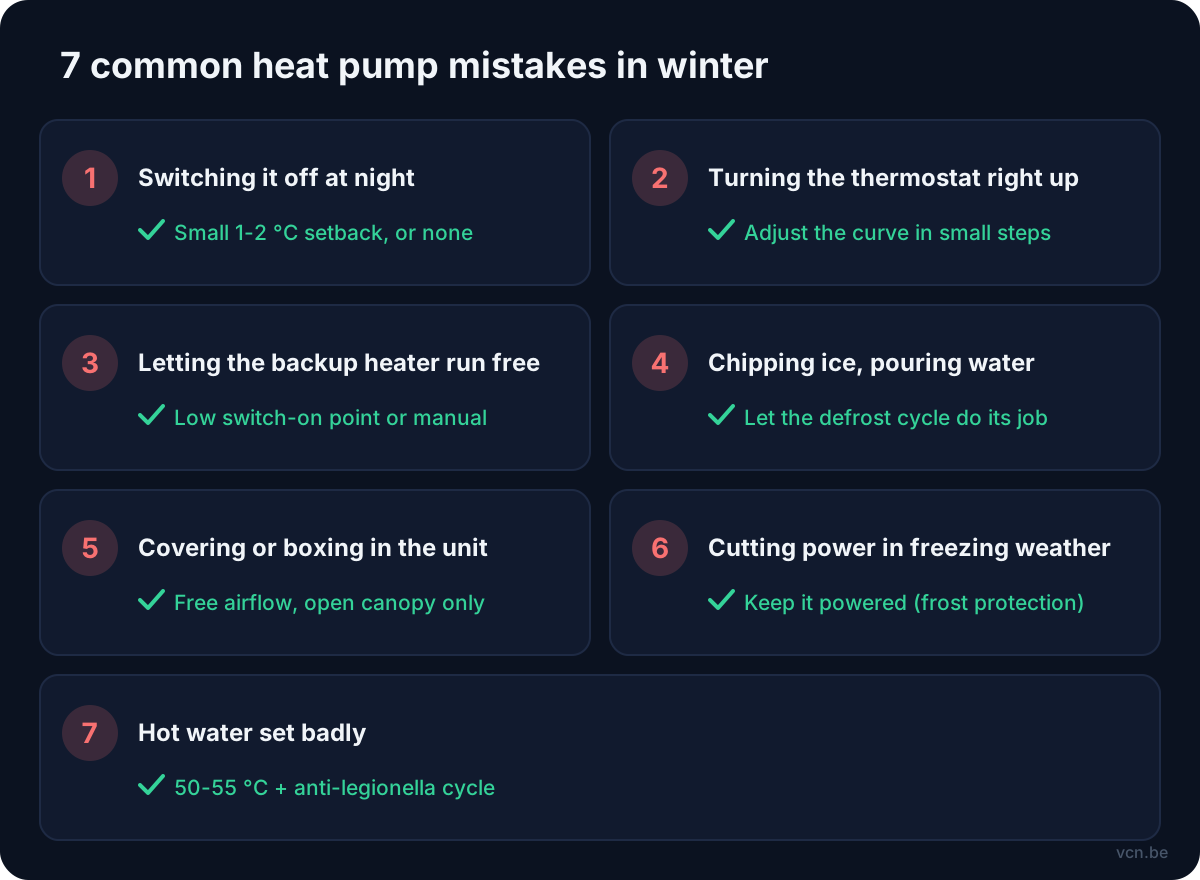
- Switching the heat pump off at night or for a short trip: the restart costs more than you save. Set back 1 to 2 °C at most.
- Turning the thermostat right up: the water gets hotter and efficiency drops. Adjust the heating curve in small steps instead.
- Letting the backup heater run freely: a switch-on point set too high makes it run from the first cold snap.
- Chipping off ice or pouring hot water: the fins get damaged and the ice comes back. Let the defrost cycle work.
- Covering or boxing in the outdoor unit: only a canopy open at the sides is acceptable.
- Cutting the power in freezing weather: without power the heat pump can no longer protect its water circuit, especially a monobloc.
- Setting hot water to extremes: 60 °C all the time is expensive, 45 °C with no anti-legionella cycle is a health risk.
Error code or breakdown in a cold snap: what should you do?
- Wait for any defrost to finish: a few minutes' pause with steam is not a breakdown.
- Note the error code and photograph the display, with the make and model.
- Check the fuse box: a heat pump often has several circuit breakers (outdoor unit, indoor unit, backup heater).
- Read the water pressure.
- Reset once following the manual. If the code comes back, do not keep trying.
- Switch on emergency mode if the manual provides for it: the backup heater then keeps a minimum of heat.
- Call a professional with that information, for example our heat pump repair service in Walloon Brabant, Brussels and Wallonia. In Belgium, a heating engineer is called a chauffagiste (French) or verwarmingsinstallateur (Dutch).
Meanwhile, close doors and shutters and keep the unit powered if it is freezing.
Annual service and F-gas obligations
The annual service keeps efficiency up, detects refrigerant leaks and checks the safety devices. Brussels Environment states that at least one service a year is generally necessary.
Since 11 March 2024, Regulation (EU) 2024/573 requires a leak check on equipment containing at least 5 tonnes CO2 equivalent of fluorinated gases: every 12 months below 50 tonnes, or every 24 months with a leak detection system. Hermetically sealed equipment labelled as such is exempt below 10 tonnes. The CO2 equivalent is the charge in kg multiplied by the refrigerant's global warming potential (GWP), using the IPCC Fourth Assessment Report values.
| Refrigerant | GWP (Annex I) | 5 t CO2e threshold | 10 t threshold (hermetic) |
|---|---|---|---|
| R32 | 675 | about 7.4 kg | about 14.8 kg |
| R410A | 2,088 | about 2.4 kg | about 4.8 kg |
| R290 (propane) | 3 | not covered: not an F-gas | not covered |
The rating plate normally shows the charge in kg and in CO2 equivalent. A small domestic R32 heat pump often stays below the threshold; with R410A, common on older units, it is reached from about 2.4 kg.
In Brussels, the Order of 29 November 2018 on refrigeration installations applies the same check frequencies and requires a logbook filled in by a qualified refrigeration technician; heat pumps above 12 kW thermal also fall under the heating and air-conditioning EPB rules (EPB, or PEB, is Belgium's energy performance of buildings framework). In Wallonia, the Order of 12 July 2007 reserves work on the refrigerant circuit to certified technicians. In Flanders, only an approved refrigeration technician (erkend koeltechnicus) may work on it.
In September 2026, a heat pump service at VCN Energy costs €205 including VAT. The VCN ONE heat pump plan includes it for €195 (Basic), €259 (Standard) or €379 (Premium) a year, with up to 20% off parts and call-outs, priority repairs within 24/48 hours and an automatic reminder (one-year commitment, two months' notice).
What winter consumption is normal?
A January bill far above October's is not necessarily abnormal: demand soars and efficiency falls in colder air. To compare fairly, use the heating degree-days published by Synergrid, the Belgian grid operators' federation (base 16.5 °C, measured at Uccle). Normal values for 1996-2025:
| Month | Normal degree-days | Share of the year |
|---|---|---|
| October | 148 | 7% |
| November | 272 | 12% |
| December | 367 | 17% |
| January | 396 | 18% |
| February | 335 | 15% |
| March | 290 | 13% |
| April | 185 | 8% |
In a normal year of 2,187 degree-days, December, January and February make up about half. Divide your heat pump's monthly consumption by that month's degree-days. Made-up example: 900 kWh in January for 396 degree-days, or about 2.3 kWh per degree-day.
If that ratio rises clearly year on year with the same use, look for the cause: backup heater over-used, curve changed, clogged filter, abnormal icing or low refrigerant.
In short
A unit that can breathe, a working drain, checked frost protection, a low curve and a controlled backup heater: that is most of the job.
Want your heat pump checked before the cold sets in? Book your service online or call VCN Energy on 010 80 20 92 (+32 10 80 20 92 from abroad).
Frequently asked questions
What temperature should I set my heat pump to in winter?
Set the room thermostat to the comfort temperature you want and let the heating curve manage the water temperature. Keep the flow temperature as low as possible: Vaillant recommends 40 °C at most and Daikin ideally 35 °C or less, depending on whether you have underfloor heating or radiators. If you feel cold, adjust the heating curve in small steps rather than turning the thermostat up.
Should I turn my heat pump down at night?
No, or only slightly. A heat pump switched off at night has to restart in the morning with hotter water, which lowers efficiency and can trigger the electric backup heater. Daikin recommends a stable temperature, no lower than around 18 °C at night. A 1 to 2 °C setback is acceptable with radiators; with underfloor heating, the slow response makes it of little use.
Why is my heat pump steaming in winter?
It is not smoke but water vapour. In cold, damp weather frost forms on the outdoor unit, so the heat pump reverses its cycle for a few minutes to melt it: this is defrosting. Steam and water come out, the fan stops, then heating resumes. Only call a technician if ice keeps building up or defrost cycles follow each other abnormally often.
What hot water temperature should a heat pump use?
A setting of 50 to 55 °C suits most households. To limit the risk of legionella, which multiplies between 25 and 45 °C, programme an anti-legionella cycle that heats the cylinder above 60 °C at regular intervals, for example once a week. Holding 60 °C permanently sharply reduces a heat pump's efficiency and raises your electricity bill.
Is heat pump maintenance mandatory in Belgium?
It is once the unit contains at least 5 tonnes CO2 equivalent of fluorinated gases: EU Regulation 2024/573 then requires a leak check at least every 12 months by a certified technician. That corresponds to about 7.4 kg of R32 or 2.4 kg of R410A. Below that it is not required everywhere, but Brussels Environment considers an annual service generally necessary.
How much electricity does a heat pump use in winter?
Far more than in autumn, and that is normal. In Belgium, December, January and February account for about half the degree-days of a normal year according to Synergrid, and heat pump efficiency falls as the air gets colder. To judge your consumption, divide the month's kWh by that month's degree-days and compare the ratio year on year, with the same use.
Sources
- Regulation (EU) 2024/573 on fluorinated greenhouse gases — EUR-Lex
- Global Warming Potential (Annex I AR4 values) — Fluorocarbons.org
- Heat pumps, air-conditioning and refrigeration equipment — Brussels Environment
- 5 tips to reduce heat pump noise — Brussels Environment
- Noise thresholds for classified installations — Brussels Environment
- Mandatory EPB checks for heating and air-conditioning — Brussels Environment
- Legionella — Sustainable Building Guide, Brussels Environment
- Approval of refrigeration technicians — Walloon Public Service (SPW)
- CoDT reform: permit exemptions from 1 May 2025 — UVCW
- Environmental aspects of heat pumps and air-conditioners — Flemish Department of Environment / VITO
- Legionellosis — Energie Plus Le Site
- Heat pump controls — Energie Plus Le Site
- Degree-days — Synergrid
- What is the heat pump defrost cycle? — Trane
- Heat pump defrosting — Mitsubishi Electric
- Outdoor unit releasing water or steam — Daikin
- Setting a heat pump — Daikin Belgium
- Installing a heat pump outdoor unit — Daikin Belgium
- Heat pump consumption — Vaillant Belgium
- Placing an outdoor unit — Viessmann Belgium
- Avoiding ice under the heat pump — NIBE
- Protecting the heat pump from frost — Caleffi
- The most efficient way to run a heat pump — Energy Saving Trust
- Abnormal neighbourhood nuisance under the new Civil Code — Marinelli law firm